
A Word That Stayed With Me
During my bachelor’s, one of my professors introduced us to a term that instantly caught my attention: El Niño. At the time, I wasn’t captivated by its scientific meaning, I simply thought the name sounded cool, the kind of word you instinctively underline in your notebook, even though you don’t yet know why. Years later, studying climate and agriculture more closely, that same underlined word explained some of the hardest years my grandfather had faced as a farmer. He never heard of the Pacific Ocean or the Niño 3.4 region, never discussed sea surface temperatures or atmospheric circulation. Yet, his farming decisions were shaped by changes taking place nearly 15,000 kilometres away.
What Exactly Is El Niño?
El Niño is a climate pattern in the Pacific Ocean, part of a larger cycle scientists call the El Niño-Southern Oscillation (ENSO). During normal conditions in the Pacific Ocean, trade winds blow west along the equator, carrying warm water from South America towards Asia. To replace that warm water, cold water rises from the depths, a process called upwelling. During El Niño, this pattern breaks down: trade winds weaken, and warm water is pushed back east, toward the west coast of the Americas.
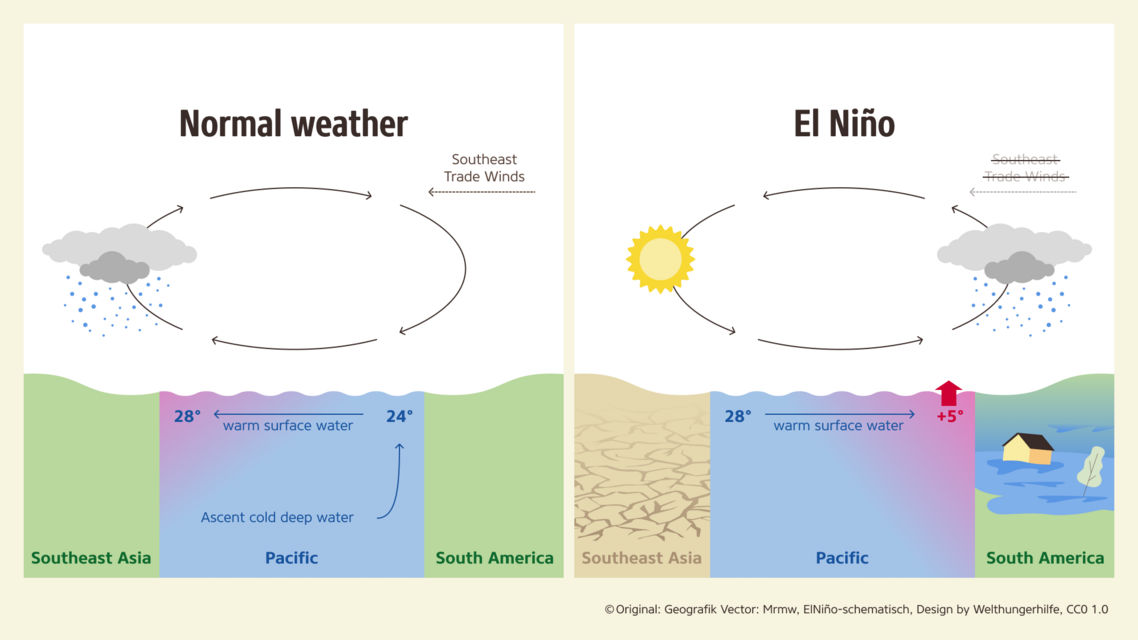
According to NOAA, El Niño events occur roughly every two to seven years, without a fixed schedule. Meteorologists track them using the Oceanic Niño Index (ONI), which measures how far above average Pacific sea surface temperatures run. An event is officially declared when the ONI stays above +0.5°C for five consecutive overlapping three-month periods. From there, the strength is graded: 0.5–1.0°C is weak, 1.0–1.5°C moderate, 1.5–2.0°C strong, and above 2.0°C very strong.
At first glance, it seems improbable that warmer ocean water near South America could influence agriculture in Nepal. But the atmosphere is remarkably interconnected. When the Pacific warms, wind patterns and moisture transport shift globally, and this often weakens the South Asian monsoon, the system responsible for most of Nepal's rainfall. Nepal's Department of Hydrology and Meteorology (DHM) has recorded that roughly 80 percent of the country's annual precipitation falls during the June - September monsoon season, which is why even modest disruptions to it ripple through the entire farming calendar.
Why the Monsoon Matters More Than We Think
For Nepali farmers, the monsoon is the calendar that organizes life: when fields are ploughed, when rice is transplanted, how much fodder livestock will have, even whether children can be sent to school. Nepal's agriculture remains heavily rain-dependent; the FAO estimates that around 79 percent of the country's total rice area is rain-fed, and even land nominally served by irrigation often gets an unreliable supply. When the rains arrive late, farming doesn't simply pause, it becomes a race against time. Delayed transplanting pushes flowering and grain-filling into cooler, shorter days, and research on Nepali rice systems has linked this shift to meaningfully lower yields, though the exact scale varies by variety, elevation, and how much irrigation backup a farmer has (Shrestha et al., 2019). For smallholders, that lost grain isn't a statistic, it's fewer meals on the table.
El Niño's fingerprints are already on Nepal's history. A study spanning more than four decades found 1992, an El Niño year, was the country's worst drought year in the 1977-2018 period, with rainfall roughly 19 % below average and nearly half the country affected (Bagale et al., 2021). A separate assessment of drought's effect on national crop yields over a similar period found that El Niño years consistently ranked among Nepal's poorest harvests, reinforcing how closely the two are linked (Hamal et al., 2020). The strong El Niño of 2015 brought one of the country's largest rainfall deficits in recent memory, a reminder that 1992 was not an isolated case.
The Possibility of a Super El Niño in 2026
By mid-2026, El Niño conditions had already developed in the Pacific, and the World Meteorological Organization was warning that the event could strengthen into a strong El Niño by the July–September period, with some forecast ensembles pointing toward the kind of ocean warming associated with a "Super El Niño". A super El Niño is an informal meteorological term for a very strong El Niño, defined by sea surface temperatures rising 2°C or more above average in the east-central equatorial Pacific Ocean. Forecasts of this magnitude are never certain, and climate systems are inherently complex. But uncertainty should never be confused with inaction. Farmers prepare for storms before they arrive; governments stock emergency supplies before disasters occur. Understanding what an El Niño year could mean for Nepal's agriculture is about reducing risk before it becomes reality, because once a monsoon underdelivers, there is very little anyone can do to recover an entire growing season.
Nepal's own outlook reflects this concern. DHM's National Season Outlook for Monsoon Season 2026 forecasts below-average rainfall and above-normal temperatures across most of the country for the June–September season, with the highest probability of deficit rainfall around 55 to 65 % in southern Karnali, most of Lumbini, eastern Madhesh, and southern Koshi provinces.
Who Bears the Greatest Burden?
When people hear about El Niño, they often imagine an entire country experiencing the same drought, crop failures, and hardships. The reality is far more complicated, and it breaks down along a few clear lines.
No crop illustrates Nepal's monsoon dependence better than rice, which occupies the largest cultivated area in the country and forms the backbone of food security. With 79 % of the rice area dependent on rainfed, late transplanting and dry spells translate directly into weaker tillering and lower grain-filling (Shrestha et al., 2019). Maize, especially in the hill districts, is at its most vulnerable during tasseling and silking: agronomic research consistently shows that even a short water deficit during this narrow flowering window can sharply reduce kernel formation, in some studies cutting yields by a third or more. Millet tolerates drought better than either crop but still suffers if the winter and pre-monsoon rains fail. Vegetables such as tomatoes, cauliflower, cucumber, chilli, ginger, turmeric, etc need comparatively steady moisture throughout the season and are often a household's main source of cash income, so water shortages can push farmers to abandon them altogether.
By geography, DHM's 2026 outlook flags southern Karnali, Lumbini, eastern Madhesh, and southern Koshi as the areas most likely to see below-normal rainfall, and these are also regions where irrigation coverage is patchiest. In the hills, the pattern looks different but is no less serious: springs that feed terraced fields dry up earlier in the season, and when rain finally arrives, hardened soil sheds water instead of absorbing it, raising the risk of erosion and landslides.
By irrigation and farm size, climate hazards tend to expose existing inequalities rather than create new ones. Farmers with assured irrigation and larger landholdings can usually absorb a weak monsoon; smallholders on rainfed land with little financial cushion cannot.
By gender, Nepali agriculture has been steadily feminizing over the past two decades, largely driven by male out-migration for work. Research on this shift shows that women left behind take on a growing share of farm management alongside household responsibilities (Gartaula, et al., 2010). When springs begin to dry, it is often women who walk further to fetch water before returning to work in the fields, meaning the burden of a weak monsoon falls disproportionately on those already carrying the most responsibility.
What an El Niño Season Can Look Like
Farmers describe a season that slowly tightens its grip. It begins in March, with waiting. Winter has already been drier than usual, and soil moisture starts to fall. Forecasts begin mentioning El Niño, but most farmers keep preparing their land anyway, hoping the outlook will be wrong. By June, waiting turns into doubt: rice seedlings are ready in the nursery beds, but the fields are too dry for transplanting. Some farmers hold off; others transplant anyway, and no one knows yet which choice will pay off. By July and August, doubt turns into stress. Instead of steady rain, long dry spells open up between isolated storms. Rice starts to yellow, vegetables wilt, and farmers cut back on fertilizer because dry soil can't carry the nutrients to the plant. When rain finally returns in September, it often arrives as short, intense downpours that run off the hardened ground rather than soaking in, eroding terraces and damaging roads instead of refilling them. By harvest, granaries hold less than expected, and families borrow money, sell livestock, or send another member abroad to make up the shortfall.
For this monsoon season, the most useful steps are the immediate, low-cost ones: farmers in the DHM-flagged high-risk districts can prioritize short-duration, drought-tolerant rice varieties already released for Nepal's rainfed lowlands (such as Sukkha Dhan or Ghaiya types, depending on elevation and local seed availability) over longer-season varieties, and can repair irrigation canals, clean ponds, and strengthen check dams before the rains are due.
Climate Change Makes Every El Niño Matter More
For generations, Nepali farmers have adapted to weather variability. But rising baseline temperatures and more intense evaporation mean future El Niño events can hit harder than past ones, even without changing in character. The real concern isn't El Niño alone; it's El Niño layered onto a warmer world, which raises the stakes for water security and food production. That uncertainty should push earlier preparation, not delay.
A warming ocean thousands of kilometres away can delay rice transplanting in Sindhupalchok. Shifting Pacific winds can decide whether a farmer in Banke harvests enough to feed a family. What I once underlined as an interesting-sounding word turned out to be a lesson my grandfather lived without ever hearing its name: agriculture is never just about soil. It's about climate, water, economics, and people. Most of all, it's about resilience, the kind he practiced every season without knowing what to call it, and the kind Nepal will need again this year. The Pacific may decide the weather. How prepared Nepal is before the first raindrop, or the first missed one, will decide the rest.