


What the“Third Pole” Means
The Hindu Kush Himalaya (HKH), encompassing the Himalaya, Karakoram, Hindu Kush, Pamirs, Tian Shan, and adjacent high mountain ranges, is widely referred to as the “Third Pole” because it stores more frozen water than any region on Earth outside the Arctic and Antarctic. This designation is not metaphorical but grounded in cryospheric mass and function. In climate science, numbers are stubborn, and they are stubbornly large. Comprehensive inventories identify approximately 54,000 glaciers covering 60,000 km², with estimated ice volumes on the order of 6,000 km², making the HKH the largest reservoir of glacier ice outside the polar ice sheets (Bolch et al., 2019; Wester et al., 2023). Well, that is not just scenery but also an infrastructure.
In addition to glacier ice, the region hosts extensive seasonal snow cover and widespread permafrost, together forming a contiguous high-elevation cryospheric system. In simpler terms: an entire climate engine built out of cold. Asia’s high mountains contain all fourteen of the world’s peaks above 8,000 m, creating polar-like thermal environments despite their mid-latitude location. As a result, latitude alone does not define cryospheric importance; elevation and areal extent can generate comparable climatic roles.
Scientific assessments, therefore, treat the HKH as a single cryospheric entity analogous to the Arctic and Antarctic. No penguins required, though. As summarized by the World Meteorological Organization, high-mountain Asia constitutes the “largest reservoir of ice and snow after the polar regions,” sustaining major river systems and supporting approximately 1.7–1.9 billion people downstream (Wester et al., 2019; World Meteorological Organization, 2022). The Third Pole may sit above the clouds, but its influence flows straight through the lowlands.
The HKH as a Global Cryospheric System
The HKH forms a critical component of the global cryosphere, the portion of Earth’s system where water exists in solid form. When water turns to ice, it stops flowing and starts governing. Snow, glacier ice, and permafrost in the HKH exhibit high surface albedo, reflecting solar radiation and exerting a stabilizing influence on Earth’s energy balance (IPCC, 2021). In this respect, the HKH performs a function similar to polar ice sheets, despite its vastly different geographic setting.
Beyond radiative effects, the HKH cryosphere interacts dynamically with atmospheric circulation. The atmosphere does not simply pass over the HKH; it is reshaped by it. The Tibetan Plateau and surrounding ranges modulate large-scale pressure gradients, influence the Asian monsoon system, and affect mid-latitude jet stream behavior. Changes in snow cover and glacier extent alter surface heating patterns, feeding back into regional and hemispheric circulation.
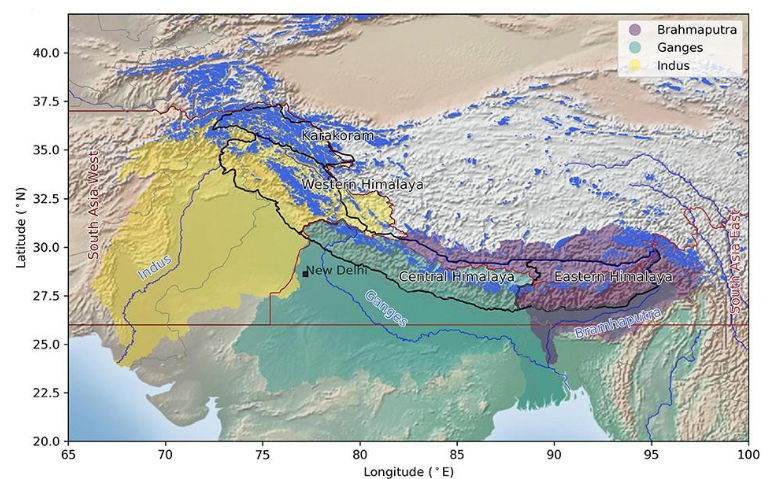
Figure 1: Map of the Himalayan River Basins Indus, Ganga, and Brahmaputra feeding from the glaciers.
Source: https://www.frontiersin.org/journals/water/articles/10.3389/frwa.2022.909246/full
Cryospheric change in the HKH also contributes incrementally to global sea-level rise through glacier mass loss, adding freshwater to the oceans. No single glacier dominates, but together, they accumulate influence. While small relative to Greenland or Antarctica, these contributions are non-negligible when aggregated across tens of thousands of glaciers. Thus, HKH stability matters not only to Asia but to the planetary climate system as a whole. High mountains, global stakes.
Water Towers at a Continental Scale
The Third Pole functions as the primary water tower for Asia, feeding ten of the continent’s major river systems: the Indus, Ganges, Brahmaputra, Amu Darya, Syr Darya, Irrawaddy, Salween, Mekong, Yellow, and Yangtze rivers. That is less a river list and more a civilization index. Together, these basins drain roughly 9 million km² and support close to two billion people, nearly one-quarter of the global population (Immerzeel et al., 2020).
Snow and glacier melt contribute disproportionately to dry-season flows. Monsoons dominate headlines; meltwater handles the fine print. In the upper Indus Basin, meltwater supplies up to 40% of annual discharge, while contributions of 13–16% are typical for the upper Ganges and Brahmaputra, rising substantially during pre-monsoon months (Lutz et al., 2014). This seasonal buffering is critical for sustaining irrigation, hydropower generation, and ecosystems during periods of low rainfall. Irrigation canals in the plains often begin as snowflakes.
Annually, HKH river systems deliver approximately 2.8 × 10^12 m³ of freshwater to downstream regions, about 8% of global river runoff. These flows underpin some of the world’s largest irrigated agricultural systems, linking high-altitude cryospheric processes directly to food production across South, Central, and East Asia. High-altitude thermodynamics, lowland food security.
Why the Third Pole Responds Faster Than Other Cryospheric Regions
Mountain regions exhibit elevation-dependent warming, whereby temperature increases intensify with altitude due to atmospheric, radiative, and land-surface feedbacks. The higher you go, the faster the thermometer moves. The HKH is among the most pronounced examples globally. Observational records indicate warming rates of 0.28 °C per decade since the mid-20th century, significantly exceeding the global average. Nearly three-tenths of a degree per decade may sound modest until you stack the decades.
This amplification renders the HKH cryosphere exceptionally sensitive to small changes in mean temperature. A fraction of a degree can redraw a snowline. Snowlines shift rapidly with warming, glacier accumulation zones contract, and permafrost thaws at thresholds close to current climatic conditions. Consequently, the Third Pole functions as an early responder within the global cryosphere, exhibiting changes earlier than many polar or low-elevation systems. Signals that remain subtle elsewhere appear unmistakable here.
Because of this sensitivity, scientists increasingly view the HKH as a diagnostic region, one where global warming signals become visible sooner and more clearly than elsewhere. The Third Pole is not just a water tower; it is a climate barometer.
The HKH as a Climate Signal Amplifier
Cryospheric change in the HKH propagates downstream through hydrological, sedimentary, and ecological pathways, often in nonlinear ways. A small disturbance at altitude rarely stays small. One key mechanism is the alteration of runoff timing. As glaciers retreat, meltwater contributions may initially increase (“peak water”) before declining sharply once ice storage diminishes. What looks like resilience can be a countdown.
Superimposed on gradual shifts are abrupt hazards. Glacier retreat promotes the formation of moraine-dammed lakes, while permafrost degradation destabilizes mountain slopes. Remove the ice, and gravity resumes control. The IPCC identifies the HKH as a hotspot for cascading hazards, including glacial lake outburst floods, landslides, and debris flows, many occurring in areas with no historical precedent. Risk expands faster than memory.
These processes transform modest atmospheric warming into amplified downstream impacts, such as earlier snowmelt, altered flood regimes, increased sediment loads, and sudden disaster events. Thus, the Third Pole converts gradual climatic forcing into visible hydrological and geomorphic signals. Gradual warming in the atmosphere becomes an abrupt reality on the ground.
What the World Inherits from Third Pole Change
Although geographically confined to Asia, the HKH exerts influence over global food systems, markets, and stability. Mountains may be regional. Supply chains are not. The Indus, Ganges, and Brahmaputra basins alone support more than 600 million people and produce substantial shares of global rice and wheat supplies. What melts in the mountains eventually appears in commodity statistics. Reduced meltwater availability would directly affect agricultural yields and indirectly influence global food prices.
Water scarcity and hydrological instability can exacerbate migration pressures and geopolitical tensions in already stressed regions. Scarcity rarely remains hydrological. Because HKH-fed basins are economically and demographically central, disruptions resonate beyond national borders through trade, humanitarian response, and climate-driven displacement.
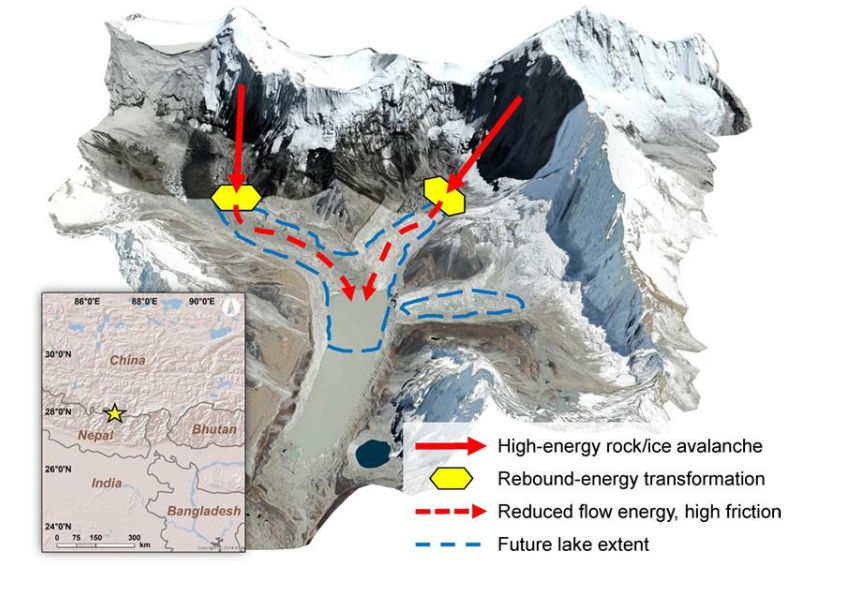
Figure 2: Visual representation of glacier retreat leading to future lake formation and downstream hazards in HKH
From a scientific perspective, the HKH provides a test case for understanding how large mountain systems respond to warming, knowledge that applies to the Andes, Alps, Rockies, and other high-elevation regions worldwide. The Third Pole is not only a water source; it is a preview.
Why the “Third Pole” Framework Matters
Framing the HKH as the “Third Pole” elevates it from a regional water source to a planetary cryospheric system. Local ice, global reverberations. This perspective emphasizes that HKH snow and ice influence Earth’s energy balance, atmospheric circulation, sea level, and continental hydrology in ways comparable though not identical to the polar ice sheets. Latitude may differ, but function does not.
Scientifically, this framing motivates global-scale observation networks, interpolar comparisons, and Earth-system modeling that integrates mountains into climate theory. The high ground demands attention. It also highlights the inadequacy of regional analyses for understanding processes that operate across spatial and temporal scales.
By concluding the foundation phase of this series, the Third Pole perspective sets the stage for the next phase: examining how rapidly warming trends are reshaping the HKH climate system itself. The following article will therefore turn from structure and significance to acceleration, exploring why the HKH is warming faster than the global average. Cold mountains, fast changes, global stakes.
References
Bolch, T., Shea, J. M., Liu, S., Azam, F. M., Gao, Y., Gruber, S., Immerzeel, W. W., Kulkarni, A., Li, H., Tahir, A. A., Zhang, G., & Zhang, Y. (2019). Status and change of the cryosphere in the extended hindu kush himalaya region. In P. Wester,
A. Mishra, A. Mukherji, & A. B. Shrestha (Eds.), The hindu kush himalaya assessment: Mountains, climate change, sustainability and people (pp. 209–255). Springer International Publishing. https://doi.org/10.1007/978-3-319-92288-1 7
Immerzeel, W. W., Lutz, A. F., Andrade, M., et al. (2020). Importance and vulnerability of the world’s water towers. Nature, 577, 364–369. https://doi.org/10.1038/s41586- 019-1822-y
IPCC. (2021). Climate change 2021: The physical science basis. contribution of working group i to the sixth assessment report of the intergovernmental panel on climate change (V. Masson-Delmotte, P. Zhai, A. Pirani, S. L. Connors, C. P´ean, S. Berger,
N. Caud, Y. Chen, L. Goldfarb, M. I. Gomis, M. Huang, K. Leitzell, E. Lonnoy,
J. B. R. Matthews, T. K. Maycock, T. Waterfield, O. Yelek¸ci, R. Yu, & B. Zhou, Eds.). Cambridge University Press. https://doi.org/10.1017/9781009157896
Lutz, A. F., Immerzeel, W. W., Shrestha, A. B., & Bierkens, M. F. P. (2014). Consistent increase in high asia’s runoff due to increasing glacier melt and precipitation. Nature Climate Change, 4, 587–592. https://doi.org/10.1038/nclimate2237
Wester, P., Chaudhary, S., Chettri, N., Jackson, M., Maharjan, A., Nepal, S., & Steiner,
J. F. (Eds.). (2023). Water, ice, society, and ecosystems in the hindu kush himalaya: An outlook. International Centre for Integrated Mountain Development (ICIMOD). https://doi.org/10.53055/ICIMOD.1028
Wester, P., Mishra, A., Mukherji, A., & Shrestha, A. B. (Eds.). (2019). The hindu kush himalaya assessment: Mountains, climate change, sustainability and people. Springer International Publishing. https://doi.org/10.1007/978-3-319-92288-1
World Meteorological Organization. (2022). State of the global climate 2021 (tech. rep.) (Provisional report released 2021; full version 2022). World Meteorological Organization. https://wmo.int/publication-series/state-of-global-climate-2021