

On the morning of August 26, 2026, north-central Nepal went from a normal Wednesday to catastrophe within minutes. A colossal mass of rock, ice, water, and mud tore down the Nepal-China border, swallowing settlements, roads, bridges, and hydropower stations along the riverbank as it went. It is estimated to be one of the deadliest disasters in Nepal’s history, and a preview of what a warming Himalaya can unleash without warning.
The instinct, when villages are wiped off a riverbank, is to picture days of relentless rain. But that isn’t what happened here. It wasn't raining that morning there was barely a drizzle. As landslide specialist Dave Petley has noted, there is no evidence that this was a glacier lake outburst flood (GLOF) either. What happened was something else entirely.
What Happened
The first sign that something was wrong came at 8:37:10 a.m. local time, when the ground began to shake. The U.S. Geological Survey (USGS) initially logged it as an earthquake, but later clarified that the 5.2 magnitude seismic signal had actually been generated by the landslide itself (Al-Jazeera, 2026).
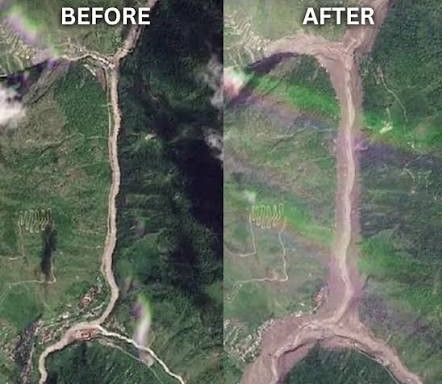
Satellite imagery later showed the cause: at roughly 5200 meters, a huge ice-rock avalanche broke loose as the base of a glacier tore away from the bedrock it had rested on. This wasn’t a slab of ice sliding off the top, but a clean structural break that took the rock beneath it along too. Daniel Shugar, a glaciologist at the University of Calgary, compared satellite images from the day before and the day of the event and found a scar roughly 610 meters across. The glacier had simply snapped.
An estimated one square kilometer of rock-glacier material broke away and fell about 1200 meters straight down the mountainside in seconds (UN News, 2026). Millions of tons of rock ground against ice at motorway speed, the friction pulverizing ice into water in mid-air as it fell.
The resulting wall of ice, rock, and mud slammed into a narrow valley and blocked the Lhende Khola, about 20 km upstream of the Nepal-China border, altering the river channel. Seconds later, the water broke free, everything that had been held let go at once, now carrying even more sand and rock than before, and gathering weight and speed with every passing second.
The surge fed into the Bhote Koshi, and then the Trishuli, whose level rose by as much as 9 meters in just 30 minutes. Scientists estimate the rock-ice avalanche released up to 142 million cubic meters of debris, the largest event of its kind ever recorded by geologists.
In Rasuwa district, Timure and Syafru Besi were among the hardest-hit settlements. Further downstream, the destruction spread through Nuwakot, Dhading, Gorkha, Tanahun, Chitwan, and Nawalparasi, eventually reaching India. Between Rasuwa and Chitwan, thousands of people were swept away, 41 motorable bridges were destroyed and four more damaged, a dozen hydropower plants were wrecked, and entire stretches of road simply disappeared.
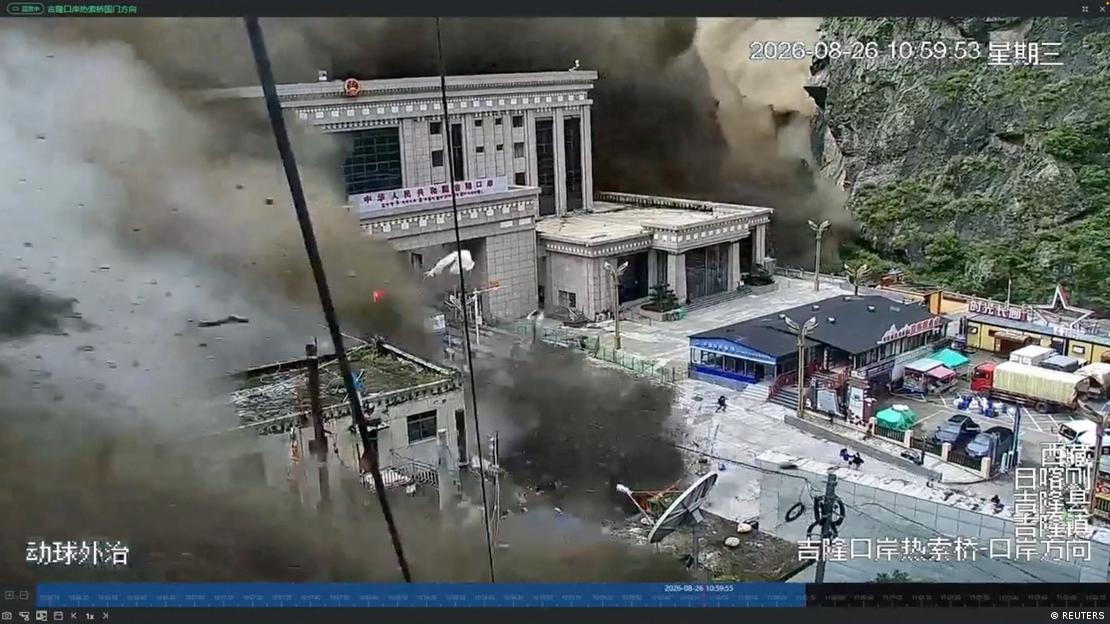
Footage that later circulated online left many people struggling to believe what they were watching. One widely shared CCTV clip captured the moment of impact, a surge arriving with a speed and height that looked less like a flood and more like a tsunami tearing through the mountains, rising so fast that there was no visible moment for anyone to run.
As for the climate change aspect as well, experts say it is "too soon to tell conclusively" whether climate change directly caused this specific collapse, even though the broader warming trend in the Hindu Kush Himalaya (HKH) is well-documented context, with confirmed studies in how the HKH has witnessed 65% faster ice loss between 2011-2020 compared to the previous decade (ICIMOD, 2023). Events like this are consistent with a pattern scientists have been flagging for years: as high-altitude permafrost and glacier beds warm, the ground that has held mountain slopes in place for centuries becomes less stable and less predictable.
Where Things Stand Today
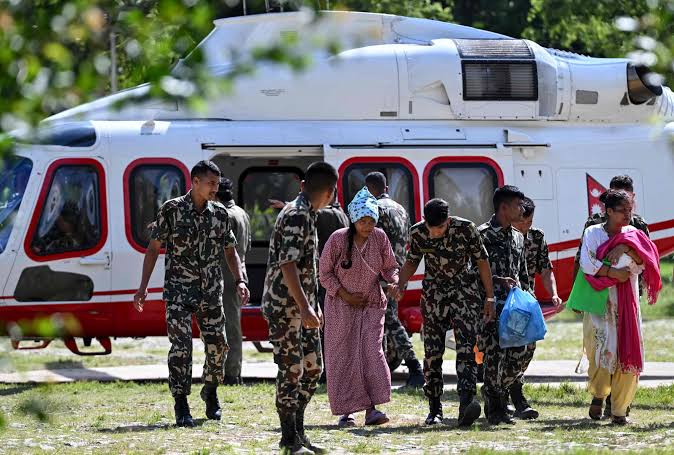
According to Nepal’s National Disaster Risk Reduction & Management Authority (NDRRMA), as of September 7, 2026, 1,356 people have died, with the largest number of dead bodies recovered in Chitwan, carried downstream from the disaster zone. A further 6,676 injured people among which 327 are receiving treatment, 4,894 still missing, and over 13,396 people have been rescued to date. Search, rescue, and verification operations are continuing, and the toll is expected to change further.
Around 21,402 security personnel have been deployed in the rescue effort: 9,287 from the Nepal Army, 7,912 from Nepal Police, and 4,203 from the Armed Police Force. International rescue teams, including teams from Korea, China, and India have also joined the joint search and rescue operations (NDRRMA, 2026).
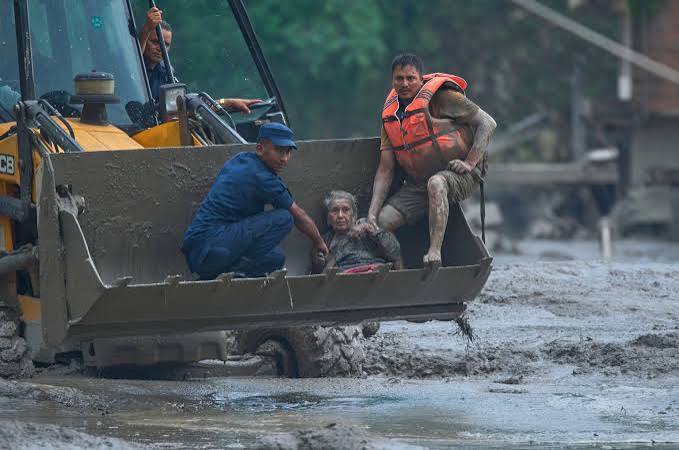
A team of 18 forensics experts from India, specialising in DNA analysis, has arrived to work alongside Nepal Police’s Central Forensic Science Laboratory and Tribhuvan University Teaching Hospital. Following standard protocols, such as those set by the International Committee of the Red Cross (ICRC), the mortal remains of the dead (especially those not recognizable, amputated, and decomposed due to longer exposure to water) have been temporarily buried. Medical teams take DNA samples from every victim before the burial so that families can match records later, and the bodies will be allowed to be exhumed for necessary rituals (The Kathmandu Post, 2026).
A preliminary assessment from Nuwakot alone recorded, 4,440 ropani/bigha of crop losses, along with 2,035 livestock and 16,500 birds lost, and a further detailed assessment is still underway across the affected districts (NDRRMA, 2026).
Domestically, Nepal currently has raised Rs. 6 billion 885 million 7,217 in balance, and an additional USD 6 million 141 thousand 702 has been deposited (The Rising Nepal, 2026).
International Response
The Asian Development Bank approved a $5 million emergency grant for rescue and relief operations (ADB, 2026), the UN released $2.5 million from the Central Emergency Response Fund to help get relief efforts moving (UNsdg, 2026), UNICEF is appealing for $17.2 million to sustain our emergency response and support early recovery until the full extent of needs is assessed (UNICEF USA, 2026). The EU allocates €2 million in humanitarian aid to support victims of flash floods in Nepal. The World Health Organization has released US$150 000 from the South-East Asia Regional Health Emergency Fund (SEARHEF) to support urgent health and other needs of the communities impacted by the devastating flash floods. WHO also mobilized and dispatched essential emergency medical supplies, including an Interagency Emergency Health Kit that can cater to the health needs of nearly 10,000 people for 3 months, along with multipurpose tents. Norway contributed NOK 10 million (approximately NPR 163 million) in humanitarian assistance in Nepal.
Financial aid has continued to arrive, along with several other essential supplies, from countries across the world.
A Shift from "Aid" to "Justice"
Nepal contributes roughly 0.05% of global greenhouse gas emissions, yet it ranks among the nations most vulnerable to severe climate impacts.
The scale of the disaster has sharpened Nepal’s language on the world stage. Foreign Minister Shishir Khanal told Kantipur: “We are shifting our diplomatic framework from ‘aid’ to ‘justice and compensation’. This is not a matter of charity, it is a matter of legal and moral liability. The major industrial emitters such as China, the United States, India, and other countries have a historical responsibility to compensate vulnerable nations like Nepal.”
It’s a framing that reflects a broader argument long made by climate-vulnerable nations that disasters like this one are not simply natural, but downstream consequences of emissions produced almost entirely elsewhere.
Relief on the Ground
Several national and international organizations have continued to provide relief materials to the flood-affected regions. Trucks and Boleros loaded with food and supplies have been dispatched to the affected areas, while additional relief materials have also been transported by flight.
A Survivor’s Story
For Anju Bhujel, 40, the flood was not simply a statistic or a headline—it was the sudden loss of the place she called home. After the disaster, Anju found herself sheltering with her children in a crowded emergency shelter in Nuwakot, facing a reality far removed from the safety and privacy of her own home. While food, clothing, and other relief materials were reaching survivors, she also had to worry about something that is often overlooked in disaster response: basic privacy and hygiene.
Inside the shelter, hundreds of survivors were sharing limited sanitation facilities, with roughly 400 people relying on just three toilets without running water. For Anju and other women, these conditions made everyday life especially difficult. Her experience shows that surviving a flood does not end when the water recedes. For many victims, the disaster continues in the form of displacement, overcrowding, inadequate sanitation, loss of privacy, and uncertainty about what comes next.
Anju’s story represents the quieter side of disaster that is rarely captured by casualty figures and damage assessments. Behind every number is a person trying to rebuild a life that was disrupted within minutes. Her experience reminds us that effective disaster response must go beyond rescue and the distribution of relief materials. It must also protect dignity, health, privacy, and the basic needs of survivors as they begin the long process of recovery.
It's the quiet resilience of Nepal's people that’s visible even in a crowded classroom shared by twenty, the women pushing for dignity amid the wreckage. It all suggests the country will rise again, and more strongly.
Rescue operations are still underway, more than a week after the ground gave way, with searchers moving through mud and debris that keep giving up more of the missing, and more of the dead. Bridges that villages depended on for decades are gone, roads have vanished into rivers that no longer follow their old paths, and hydropower plants that lit homes and powered small businesses now sit buried or swept away entirely, across districts left to rebuild almost from nothing, with resources Nepal does not have enough of on its own.
The numbers, however staggering, don't fully hold what's been lost. Behind every count is a name, a face, a family altered in the span of a few minutes, more than a thousand people confirmed dead, thousands more still unaccounted for, and families still waiting by shelter doors for news that, for many, may never come.
Nepal has been broken by disaster before, and has found its way back each time. It will have to find that way back again. But rising shouldn't mean doing it alone, and it shouldn't mean doing it in silence.