


Our cities are getting hotter
As urbanisation rapidly takes place in Nepal, cities like Kathmandu Metropolitan City and Pokhara Metropolitan City are becoming hotter than their surrounding rural and suburban areas (Jamarkattel et al., 2025; Karunaratne et al., 2022). This phenomenon, where a built-up area consistently has higher temperatures than its surroundings, creating a distinct “warm island”, is known as the Urban Heat Island (UHI) effect. In the past decade, significant expansion of built-up areas alongside shrinking vegetation cover has driven consistent warming across both summer and winter seasons, though the effect is more pronounced during summer (Khatri et al., 2025). The trajectory is concerning with research projecting winter temperatures ranging from 9.34°C to 30.12°C, and summer temperatures ranging from 19.74°C to 42.32°C in Kathmandu by 2030 (Khatri et al., 2025). These figures are significantly higher than what we currently experience, and arguably higher than what we can comfortably tolerate.
This intensifying heat isn’t accidental or natural. It is a direct consequence of how these cities are growing. Rapid urbanisation and population growth have steadily taken over green spaces and water bodies, both of which naturally regulate temperature through shade and evaporative cooling. Their place has been taken over by concrete and impervious surfaces that absorb and retain heat. Concrete buildings can also trap heat in the spaces between adjoining buildings (Singh et al., 2020). Layered on top of this is anthropogenic heat is the collective heat generated by vehicles, air conditioning units, generators and daily human activity, which adds directly to the ambient temperature. Together, these forces have contributed to significant warming in Nepali cities.
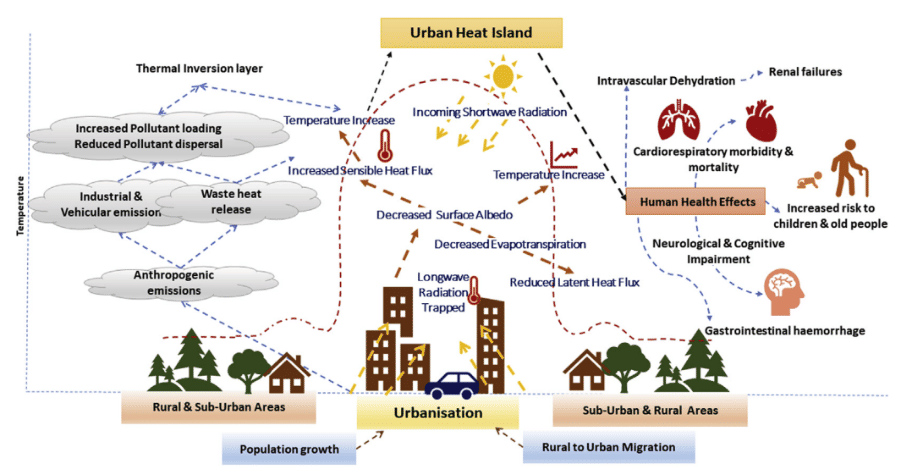
Consequences of UHI
With more than half of the world’s population now living in urban areas, the number of people exposed to the health consequences of UHI is immense. Elevated ambient temperatures, combined with reduced surface moisture and vegetation, significantly increase the risk of heat-related illnesses and mortality among urban residents (Piracha and Chaudhary, 2022). The mechanisms behind this are physiological as much as environmental. Heat causes vasodilation, the widening of blood vessels, which can lower blood pressure; research has found that with a 1°C rise in ambient temperature, there is a reduction of 0.659 and 0.368 mmHg in systolic and diastolic blood pressures, respectively (Singh et al., 2020). Sustained heat exposure can also trigger intravascular dehydration, leading to dizziness, nausea and unconsciousness, while hyperthermia, the body’s failure to regulate its own temperature, can impair neurological and cognitive dysfunction, adversely affecting memory and attention (Singh et al., 2020). In other words, UHI does not only make city life uncomfortable, but it also directly compromises the body’s ability to function.
Beyond individual health, UHI carries profound socioeconomic consequences that ripple through how a city functions. Infrastructure itself is vulnerable to extreme heat: asphalt can soften and deform, while train rails can buckle under sustained high temperatures, disrupting transportation networks. Rising temperatures also drive greater reliance on air conditioning, which increases energy demand and cost (Bhandari and Zhang, 2022). Increased use of air conditioning can contribute to emissions driven by energy production, causing further warming. The social costs are equally significant. Higher temperatures have been linked to reduced labour productivity and increased rates of delinquency, and they can impair the social development of children and young people by interfering with their ability to play and socialise outdoors (Assari and Zare, 2024; UK Aid, 2017). Crucially, these burdens are not distributed equally; UHI disproportionately affects low-income communities who often lack the financial means to adapt to rising heat.
The consequences of UHI extend beyond human health and society into the ecosystem cities are built in. Elevated urban temperatures can disrupt local ecological functions in ways that vary by species. Some plants benefit from longer growing seasons and higher rates of photosynthesis in warmer urban conditions, while others, including many urban trees, experience reduced growth due to heat-induced water stress (Frank and Backe, 2023). Similarly, urban arthropods, which often already live close to their thermal limits, can face measurable consequences for fitness and distribution (Frank and Backe, 2023). Over time, UHI functions as a kind of ecological filter: it favours heat-tolerant, generalist species while pushing out more specialised ones, gradually reshaping the composition of urban ecosystems. This shift can also facilitate the spread of vector species, raising the risk of vector-borne disease transmission in affected areas.
Building resilience at the individual and city level
Building resilience to UHI, at both city and individual level, is essential as urban heat continues to intensify. At the city level, one of the most direct interventions is the use of cooling materials with high solar reflectivity on roofs and pavements (Han et al., 2023). By reflecting a large portion of incoming solar radiation rather than absorbing it, these materials significantly reduce surface temperatures compared to conventional dark asphalt and roofing.
A related but distinct approach is the use of permeable and water-retaining (PWR) materials, which cool surfaces through evaporation rather than reflection (Han et al., 2023). PWR pavements are designed with gaps in their surface layer that allow rainwater to pass through into underlying storage structures. On sunny days, this stored water gradually evaporates, drawing heat from the surface and helping regulate the pavement’s thermal behaviour throughout the day.
Green infrastructure offers a third avenue for cooling. Parks and green spaces create a measurable cooling effect, often forming what researchers call “cool islands” (Han et al., 2023). A study in Lisbon, Portugal, for instance, found that park areas were on average 6.9°C cooler than their surrounding urban environment (Oliveira et al., 2011). This is a striking illustration of how much of a difference vegetation cover can make. Local governments can act on this by prioritizing tree planting and the development of new parks and green spaces across the city.
Alongside these preventive measures, cities also need to prepare their emergency response systems (An and Dedekorkut-Howes, 2025). As heat-related illness becomes more common, medical response teams must be adequately equipped and trained to manage the resulting rise in heat-related medical cases.
City-level interventions alone are not enough; behavioural change at the individual level is an equally important part of building resilience (An and Dedekorkut-Howes, 2025). This involves both raising public awareness of heat risks and encouraging simple protective habits: staying hydrated, seeking shade during peak heat hours, wearing appropriate clothing, and avoiding strenuous outdoor activity when temperatures are highest. While modest individually, these behaviours play a critical role in reducing personal exposure and risk during periods of extreme urban heat.
Conclusion
As Kathmandu, Pokhara, and other rapidly urbanising cities in Nepal continue to expand, the Urban Heat Island effect is no longer a distant projection. It is a present and intensifying reality with consequences that reach into every corner of urban life, from individual health and city infrastructure to the ecosystems these cities are built upon. The choices being made today, in how cities are planned, built, and greened, will determine how liveable they remain in the future. Encouragingly, the tools to respond already exists. We simply need to act, through coordinated planning at the city level and everyday adaptation at the individual level, before the temperatures projected for 2030 become the new normal.
References
An, S. and Dedekorkut-Howes, A. (2025) A Review of Adaptation Strategies to Increased Urban Temperatures and Heat Island Effect. Discover Cities, 2 (1). doi:10.1007/s44327-025-00064-4.
Assari, S. and Zare, H. (2024) Extreme Heat Exposure Is Associated with Higher Socioeconomic Disadvantage and Elevated Youth Delinquency. Trends Journal of Sciences Research, 3 (1). doi:10.31586/jsmhes.2024.1044.
Bhandari, S. and Zhang, C. (2022) Urban Green Space Prioritization to Mitigate Air Pollution and the Urban Heat Island Effect in Kathmandu Metropolitan City, Nepal. Land, 11 (11). doi:10.3390/land11112074.
Frank, S.D. and Backe, K.M. (2023) Effects of Urban Heat Islands on Temperate Forest Trees and Arthropods. Current Forestry Reports. 9 (1). doi:10.1007/s40725-022-00178-7.
Han, D., Zhang, T., Qin, Y., et al. (2023) A comparative review on the mitigation strategies of urban heat island (UHI): a pathway for sustainable urban development. Climate and Development. 15 (5). doi:10.1080/17565529.2022.2092051.
Jamarkattel, U., Lamichhane, B.R., Gautam, S., et al. (2025) Analyzing Urban Heat Islands in Pokhara Metropolitan City-Nepal through Remote Sensing Techniques. Remote Sensing Applications: Society and Environment, 37. doi:10.1016/j.rsase.2025.101479.
Karunaratne, S., Athukorala, D., Murayama, Y., et al. (2022) Assessing Surface Urban Heat Island Related to Land Use/Land Cover Composition and Pattern in the Temperate Mountain Valley City of Kathmandu, Nepal. Remote Sensing, 14 (16). doi:10.3390/rs14164047.
Khatri, B., Kharel, B., Dhakal, P., et al. (2025) Spatio-temporal dynamics of urban heat island using Google Earth Engine: Assessment and prediction—A case study of Kathmandu Valley, Nepal. Climate Services, 38. doi:10.1016/j.cliser.2025.100560.
Oliveira, S., Andrade, H. and Vaz, T. (2011) The cooling effect of green spaces as a contribution to the mitigation of urban heat: A case study in Lisbon. Building and Environment, 46 (11). doi:10.1016/j.buildenv.2011.04.034.
Piracha, A. and Chaudhary, M.T. (2022) Urban Air Pollution, Urban Heat Island and Human Health: A Review of the Literature. Sustainability (Switzerland), 14 (15). doi:10.3390/su14159234.
Singh, N., Singh, S. and Mall, R.K. (2020) “Urban ecology and human health: implications of urban heat island, air pollution and climate change nexus.” In Urban Ecology: Emerging Patterns and Social-Ecological Systems. doi:10.1016/B978-0-12-820730-7.00017-3.
UK Aid (2017) Impacts of higher temperatures on labour productivity and value for money adaptation: lessons from five DFID priority country case studies.
Cover image by Subash Shrestha. Obtained from: https://www.dw.com/en/nepal-struggles-with-blistering-heat-wave/a-65941491