


Flooding in Nepal
Nepal witnessed extremely heavy rainfall from 26th to 28th September 2024, leading to devastating flash floods in the Koshi basin and riverine flooding from Bagmati, Sapakoshi and Nakkhu rivers across several districts in Nepal, particularly in Kathmandu Valley (Zachariah et al., 2024). 11 stations inside the valley monitored by the Department of Hydrology and Meteorology (DHM) broke previous records for extreme 24-hour rainfall with some areas receiving up to 323.5 mm rainfall on 28 September (DHM, 2024). This extreme rainfall pushed the water levels of the Bagmati River to 2.2 meters above the danger mark. Flooding was severe in low-lying areas of Makawanpur, Kathmandu, Sarlahi and Mahottari due to the release of water from Kulekhani Dam, an action taken only for the second time in 25 years (Zachariah et al., 2024). The disaster resulted in around 250 fatalities and affected over 15,000 families.
The September 2024 flood in Nepal isn’t the first of its kind. Nepal is continuously under threat from floods, with high consequent loss throughout history (Pangali Sharma et al., 2019). In recent years, precipitation patterns have become more erratic with longer dry spells and sudden, intense downpours. Unpredictable and extreme rainfall events have led to exacerbated flood risks in Nepal, especially in urban areas (Talchabhadel et al., 2025). Rapid urbanisation, including informal settlements and construction near riverbanks and floodplains, increased gravel and sand mining, and encroachment of rivers, floodplains and wetlands have resulted in increased intensity and frequency of flood events (Lamichhane et al., 2025; Zachariah et al., 2024; Talchabhadel et al., 2025). Consequences of extreme flood events can be severe for a developing nation like Nepal, from loss of life and damage to infrastructures, communication systems and health facilities to outbreaks of diseases and displacement. With flood events becoming more frequent and intense due to climate change, there is an urgent need to effectively manage this hazard.
Nature-based flood management and its measures
Nature-based flood management (NFM) refers to the use of natural processes and landscape features to reduce flood risk (Lane, 2017). In recent years, NFM has been increasingly advocated as a sustainable alternative to traditional flood management (TFM) approaches, such as dams, embankments and levees, which carry well-documented environmental costs and are typically more expensive to implement and manage (Xu et al., 2021).
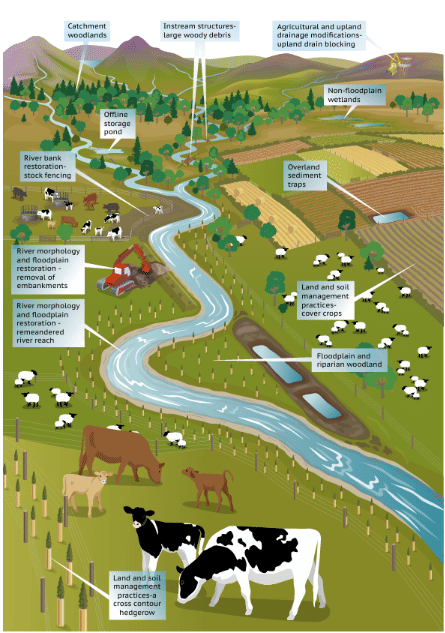
The core principle of NFM is straightforward: reduce the volume of water and runoff entering river channels or slow it down before the runoff gets there (Forbes et al., n.d.; Lane, 2017). Rather than containing the floodwaters, NFM intervenes earlier in the water cycle. Some common NFM measures are as follows (Forbes et al., n.d.):
Woodland creation: Trees, particularly in floodplain and riparian areas, are one of the most effective NFM interventions. Their canopies intercept rainfall before it reaches the ground, and their root systems enhance soil structure, increasing the soil’s capacity to absorb water. This results in less surface runoff entering rivers during heavy rainfall. Beyond flood management, riparian woodlands provide significant ecological benefits, including wildlife habitat and improved conditions for aquatic species through increased canopy shade.
Land and soil management: The way land is managed, particularly agricultural land, has a direct impact on how much runoff it generates. Poorly managed soils become compacted and less permeable, causing rainfall to slide off the surface rather than being absorbed. Sustainable land management practices such as soil aeration, reduced heavy machinery use, and installation of buffer strips can substantially improve soil infiltration capacity, reducing both the volume and rate of runoff.
River and floodplain restoration: Many rivers have been artificially straightened or modified, which accelerates water flow and increases flood risk downstream. NFM seeks to reverse this by restoring more natural river dynamics by re-meandering straightened channels, reducing excessive sediment supply, and replanting floodplain vegetation. Engineered log jams, which mimic natural woody debris accumulations, are also used to slow flow velocity and encourage water to spread laterally across the floodplain rather than flow downstream.
Multiple benefits of NFM
Flood protection is only one part of the picture. One of NFM’s strongest arguments over traditional engineering approaches is its capacity to deliver multiple benefits simultaneously (Forbes et al., n.d.). They span ecology, climate resilience, and food production. Some of NFM’s co-benefits are as follows (Forbes et al., n.d.):
Biodiversity: Many NFM measures work by restoring degraded ecosystems, which in turn creates conditions for a wider range of habitats and species to thrive. River restoration, such as re-meandering, reintroduces habitat diversity that straightened channels lack, benefitting species like salmon that depend on varied flow conditions. Similarly, woodland creation supports complex ecosystems beneath the canopy, providing habitat for invertebrates, birds, and mammals.
Climate change adaptation: NFM contributes to climate resilience by building ecosystems that are better equipped to absorb and recover from climate-driven disturbances, and by directly addressing greenhouse gas concentrations. Wetland restoration and woodland plantation are effective carbon sinks, removing carbon dioxide from the atmosphere and storing it in vegetation and soils. As the frequency and intensity of extreme conditions increase under climate change, the adaptive capacity that NFM builds into landscapes becomes increasingly valuable.
Agricultural production: NFM measures that improve soil structure directly benefit agricultural productivity. Practices such as cover cropping to reduce compaction and increase the soil’s ability to retain moisture, buffering farmland against drought conditions that might otherwise damage crops. Reduced surface runoff also means fewer agricultural chemicals are carried into watercourses, thereby/thus improving water quality. Rather than competing with agricultural land use, well-designed NFM can actively support it.
These benefits are particularly relevant in Nepal, one of the most flood-vulnerable countries in the world, where the need for sustainable and affordable flood management has never been greater.
Application of NFM in Nepal
The case for NFM in Nepal is compelling on paper. However, its application is complicated.
Nepal does not currently have any policy framework that addresses NFM directly. However, nature-based approaches are not absent from policy altogether. Several existing frameworks gesture towards NFM principles under the broader umbrella of nature-based solutions (NbS), approaches that use natural processes to address environmental challenges (Poudel et al., 2024). The National Wetlands Policy 2003, and its revised version in 2012, for instance, emphasise wetland conservation and management. Wetland conservation is itself an NFM measure with direct flood regulation benefits, even if it is not framed as such. In this sense, NFM is implicitly present in Nepal’s policy landscape without the targeted focus required for effective implementation of policies.
This policy gap is also reflected in research. The majority of academic and institutional research in Nepal concentrates on nature-based solutions for natural disasters broadly, rather than on NFM as a distinct intervention (Poudel et al., 2024; Mukherjee et al., 2022). This matters because NFM’s credibility as a flood management tool depends heavily on documented, site-specific evidence. Without a robust evidence base, it becomes difficult to make the case to policymakers and communities for prioritising NFM over more familiar, visible infrastructures like embankments (Ellis et al., 2021).
It is worth noting that Nepal is not an outlier here. Globally, the lack of large-scale, well-documented NFM success stories remains one of the biggest barriers to its wider adoption (Raška et al., 2022; Lane, 2017). Evidence for NFM’s effectiveness is strongest at small catchment scales, and the science behind NFM in complex, high-altitude Himalayan terrain is still developing (Raška et al., 2022). Nepal’s limited evidence base is therefore a reflection of a broader global gap, not simply a local failing.
However, even where the will to implement NFM exists, it faces inherent challenges. NFM only works effectively when applied to the entire catchment. Application to a singular river system can cause flooding downstream. In Nepal, this is complicated as major river systems like the Koshi River are transboundary, crossing into India and China, making internationally coordinated management politically difficult. It also works best when combined with traditional flood management approaches, particularly in extreme flood events. Presenting it as a complete replacement is an overclaim that evidence doesn’t support.
The way forward
Despite these limitations, there is still optimism for NFM’s implementation. Nepal’s community forestry programme, one of the most successful of its kind in the world, already functions as a part of NFM, reducing surface runoff and stabilising slopes across the middle hills (Laudari et al., 2024). This represents an opportunity for NFM initiative to be built upon rather than starting from scratch.
Growing international interest in NFM also presents a funding opportunity for a vulnerable nation like Nepal. Political will to formalise NFM for flood risk management and climate resilience policy is crucial.
Nepal has the ecological context, the community-level practice, and the climate urgency to make NFM work. What it needs now is the evidence, the policy recognition, and the investment to bring it to scale.
References
Ellis, N., Anderson, K. and Brazier, R. (2021) Mainstreaming natural flood management: A proposed research framework derived from a critical evaluation of current knowledge. Progress in Physical Geography, 45 (6). doi:10.1177/0309133321997299.
Forbes, H., McLay, F. and Ball, K. (n.d.) Natural Flood Management Handbook. Available at: www.sepa.org.uk.
Lamichhane, K., Karki, S., Sharma, K., et al. (2025) Unraveling the causes and impacts of increasing flood disasters in the kathmandu valley: Lessons from the unprecedented September 2024 floods. Natural Hazards Research, 5 (4). doi:10.1016/j.nhres.2025.04.001.
Lane, S.N. (2017) Natural flood management. Wiley Interdisciplinary Reviews: Water, 4 (3). doi:10.1002/WAT2.1211.
Laudari, H.K., Sapkota, L.M., Maraseni, T., et al. (2024) Community forestry in a changing context: A perspective from Nepal’s mid-hill. Land Use Policy, 138. doi:10.1016/j.landusepol.2023.107018.
Mukherjee, M., Wickramasinghe, D., Chowdhooree, I., et al. (2022) Nature-Based Resilience: Experiences of Five Cities from South Asia. International Journal of Environmental Research and Public Health, 19 (19). doi:10.3390/ijerph191911846.
Pangali Sharma, T.P., Zhang, J., Koju, U.A., et al. (2019) Review of flood disaster studies in Nepal: A remote sensing perspective. International Journal of Disaster Risk Reduction. 34. doi:10.1016/j.ijdrr.2018.11.022.
Poudel, S., Wickramasinghe, D., Mukherjee, M., et al. (2024) The status and prospect on nature-based solution in South Asia: A policy-based analysis. PLOS Climate, 3 (3). doi:10.1371/journal.pclm.0000289.
Raška, P., Bezak, N., Ferreira, C.S.S., et al. (2022) Identifying barriers for nature-based solutions in flood risk management: An interdisciplinary overview using expert community approach. Journal of Environmental Management, 310. doi:10.1016/j.jenvman.2022.114725.
Situational Report on Extreme Precipitation and Flooding Event of (2024).
Talchabhadel, R., Panthi, J., Pandey, V.P., et al. (2025) Yesterday’s extremes, today’s new normal: flood risk in the Kathmandu Valley, Nepal. Natural Hazards, 121 (16). doi:10.1007/s11069-025-07524-5.
Xu, C., Liu, Z., Chen, Z., et al. (2021) Environmental and economic benefit comparison between coupled grey-green infrastructure system and traditional grey one through a life cycle perspective. Resources, Conservation and Recycling, 174. doi:10.1016/j.resconrec.2021.105804.
Zachariah, M., Jha, R., Mondal, A., et al. (2024) Rapid urbanisation and climate change: key drivers of dramatic flood impacts in Nepal.