


The Himalayas have long been regarded as a symbol of environmental purity; vast and seemingly untouched. Today, that assumption no longer holds. Microplastics (MPs), one of the most omnipresent pollutants of the modern era, have been detected across the region, including Mount Everest (Napper et al., 2020). MPs have emerged as an invisible global threat to environmental and human health worldwide. Their presence in one of the world's most remote mountain ranges signals that no environment, however isolated, remains pristine.
The invisible pollutant
The term microplastic was first introduced by Thompson et al., (2004) to describe microscopic fragments of plastic debris found in the environment. In the two decades since, microplastic research has expanded considerably. MPs are now formally defined as solid plastic particles ≤ 5 mm in size that are composed of polymers and functional additives (Thompson et al., 2024). They may also carry intentionally or unintentionally added chemicals. The 5 mm maximum size threshold matters because particles up to 5mm can be easily ingested by organisms, leading to different risks compared to the ingestion of larger particles. Particles below the size of 1 micrometre (µm) fall into a separate category, nanoplastics, which remain difficult to detect and analyse individually due to their extremely small size.
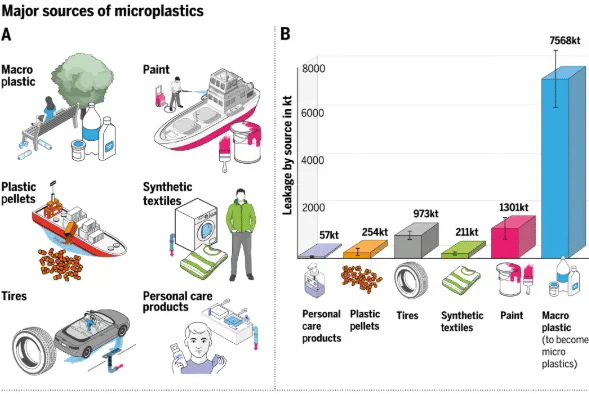
MPs have been divided into subcategories based on their sources - primary and secondary microplastics. Primary MPs are intentionally manufactured to be microscopic, while secondary MPs are created from the environmental breakdown of larger plastics. Early studies identified several sources of secondary MPs, such as textile fibres, cosmetic products and fragmentation of larger items, whereas recent research has expanded the list to include paint, tyre abrasion, mechanical recycling, and preproduction flakes and powders (Thompson et al., 2024).
Reaching the Himalayas
The main source of microplastics in the Nepal Himalayas is human activities, indicated by the fact that areas with settlements have the greatest concentration of microplastics (Han et al., 2024). Human activities like hiking, agricultural practices, and plastic waste disposal are major sources of MPs. Trekkers often wear clothing made from synthetic textiles, and the fibres that shred from these clothes are a large source of MPs in the Nepal Himalayas, with fibres making up more than 90% of MPs identified in the region (Napper et al., 2020). Improper plastic waste disposal resulting from various tourism activities is also a leading cause of MPs. Waste that is improperly disposed of, such as water bottles, is known as macroplastics, plastic with sizes above 5 cm. These macroplastics can undergo physical degradation, such as wear and tear, abrasion and friction, and chemical degradation, such as chemical leaching and photodegradation, resulting in the formation of microplastics (Gray et al., 2025). Macroplastics can also undergo biodegradation to form MPs; however, this process is very slow. MPs can further undergo these fragmentation processes to form even smaller MPs or nanoplastics (Kamalasekaran and Sundramoorthy, 2026).
Another major pathway of MP occurrence is atmospheric deposition (Han et al., 2024). The majority of the MPs present in the Nepal Himalayas come from atmospheric transport from other parts of the country and even the world. Due to the small size of MPs, they can be easily lifted off the surface by wind and enter the lower atmosphere. MPs can then be carried over vast distances from their source to remote locations like the Nepal Himalayas. As MPs float through the atmosphere, they interact with moisture and ice crystals present in clouds. As these clouds precipitate, MPs bind with snow or raindrops and thus reach the surface (Napper et al., 2020). Once deposited, MPs can become trapped under layers of snow and ice. Over time, as temperature rises and glaciers melt, the MPs are released into meltwater streams, reaching the lakes and rivers. Rivers can introduce MPs to the local population and communities further downstream.
Consequences of microplastic pollution
Consequences of microplastics in the Nepal Himalayas span ecosystems, wildlife, and human health. Due to their greater surface area and hydrophobic nature, MPs can get ingested by terrestrial and aquatic organisms in the Nepal Himalaya, leading to health consequences such as inhibited secretion of gastric enzymes, delayed ovulation, infertility, and blockage of intestinal tracts (Talukdar et al., 2023). Plants are not immune either; uptake of MPs from the soil can lead to development and growth issues while introducing MPs into the food chain if consumed (Khalid et al., 2020).
For local populations, the threat is direct and well-evidenced. MPs have been detected in human blood, placenta, liver, and kidney (Thompson et al., 2024). MPs can be ingested through food and inhalation, causing an inflammatory response in the gastrointestinal system, neurodegenerative diseases, and cancer (Talukdar et al., 2023). Himalayan population and tourism have seen a steep increase in recent years, exposing more people to MPs and their consequences. Since medical facilities are limited and access is difficult in many remote locations, the population can be disproportionately affected by the health consequences of MPs.
A further dimension of concern is the potential of MPs to act as vectors for other pollutants like persistent organic pollutants (POPs). MPs can absorb, transport, and release chemicals and other pollutants, amplifying their own toxicity. Research has shown that a combination of MPs and other pollutants displayed greater toxicity than MPs alone (Menéndez-Pedriza and Jaumot, 2020), raising the possibility that MPs can also introduce and intensify chemical pollution in a region with little prior exposure.
Path forward
Addressing microplastic pollution in the Nepal Himalayas requires tackling the broader issue of plastic waste management. The region attracts massive numbers of domestic and international tourists, resulting in the generation of an unmanageable volume of plastic waste. Given the challenging terrain and climatic conditions, clean-up efforts are difficult. Stronger tourism policies, targeted clean-up and monitoring activities, and the promotion of non-plastic alternatives are necessary steps forward. It is equally important to involve multiple stakeholders, local governments, waste collectors, hotel owners, tour operators and local communities, who must be educated about the issue and whose perspectives should shape policy and projects. Given that the majority of the region’s MP burden comes from atmospheric deposition, nationwide plastic waste management strategies are essential to reducing the problem in the long run.
At an individual level, change begins with awareness. Learning to identify which products we use contain or release plastic, opting for alternatives, and committing to responsible disposal, reuse, and recycling contribute to the solution. Crucially, geographic distance from the Himalayas does not mean an absence of impact. Our everyday choices can ultimately contribute to microplastic deposition even in the most remote corners of the region. Acting responsibly, however small the individual contribution may seem, is an essential path forward.
References
Gray, A., Gore, B., Gaesser, M., et al. (2025) Insights into the in-situ degradation and fragmentation of macroplastics in a low-order riverine system. Environmental Toxicology and Chemistry, 44 (7). doi:10.1093/etojnl/vgaf116.
Han, B., Yacoub, M., Li, A., et al. (2024) Human Activities Increased Microplastics Contamination in the Himalaya Mountains. Hydrology, 11 (1). doi:10.3390/hydrology11010004.
Kamalasekaran, K. and Sundramoorthy, A.K. (2026) A review on microplastics: sources, environmental fate, degradation pathways, and analytical identification methods. RSC Advances. 16 (15) pp. 13851–13874. doi:10.1039/d5ra09062h.
Khalid, N., Aqeel, M. and Noman, A. (2020) Microplastics could be a threat to plants in terrestrial systems directly or indirectly. Environmental Pollution. 267. doi:10.1016/j.envpol.2020.115653.
Menéndez-Pedriza, A. and Jaumot, J. (2020) Interaction of environmental pollutants with microplastics: A critical review of sorption factors, bioaccumulation and ecotoxicological effects. Toxics. 8 (2). doi:10.3390/TOXICS8020040.
Napper, I.E., Davies, B.F.R., Clifford, H., et al. (2020) Reaching New Heights in Plastic Pollution—Preliminary Findings of Microplastics on Mount Everest. One Earth, 3 (5). doi:10.1016/j.oneear.2020.10.020.
Talukdar, A., Bhattacharya, S., Bandyopadhyay, A., et al. (2023) Microplastic pollution in the Himalayas: Occurrence, distribution, accumulation and environmental impacts. Science of the Total Environment. 874. doi:10.1016/j.scitotenv.2023.162495.
Thompson, R.C., Courtene-Jones, W., Boucher, J., et al. (2024) Twenty years of microplastic pollution research—what have we learned? Science. 386 (6720). doi:10.1126/science.adl2746.
Thompson, R.C., Olson, Y., Mitchell, R.P., et al. (2004) Lost at Sea: Where Is All the Plastic? Science, 304 (5672). doi:10.1126/science.1094559.