


How Pollution Travels to the Himalayas and Makes Snow Melt Faster
The smoke released by vehicles, industries and burning fields does not always remain where it is produced. Carried by winds across South Asia and through Himalayan valleys, fine particles of pollution can reach some of the world's highest mountains, settle on snow and ice, and make them absorb more heat.
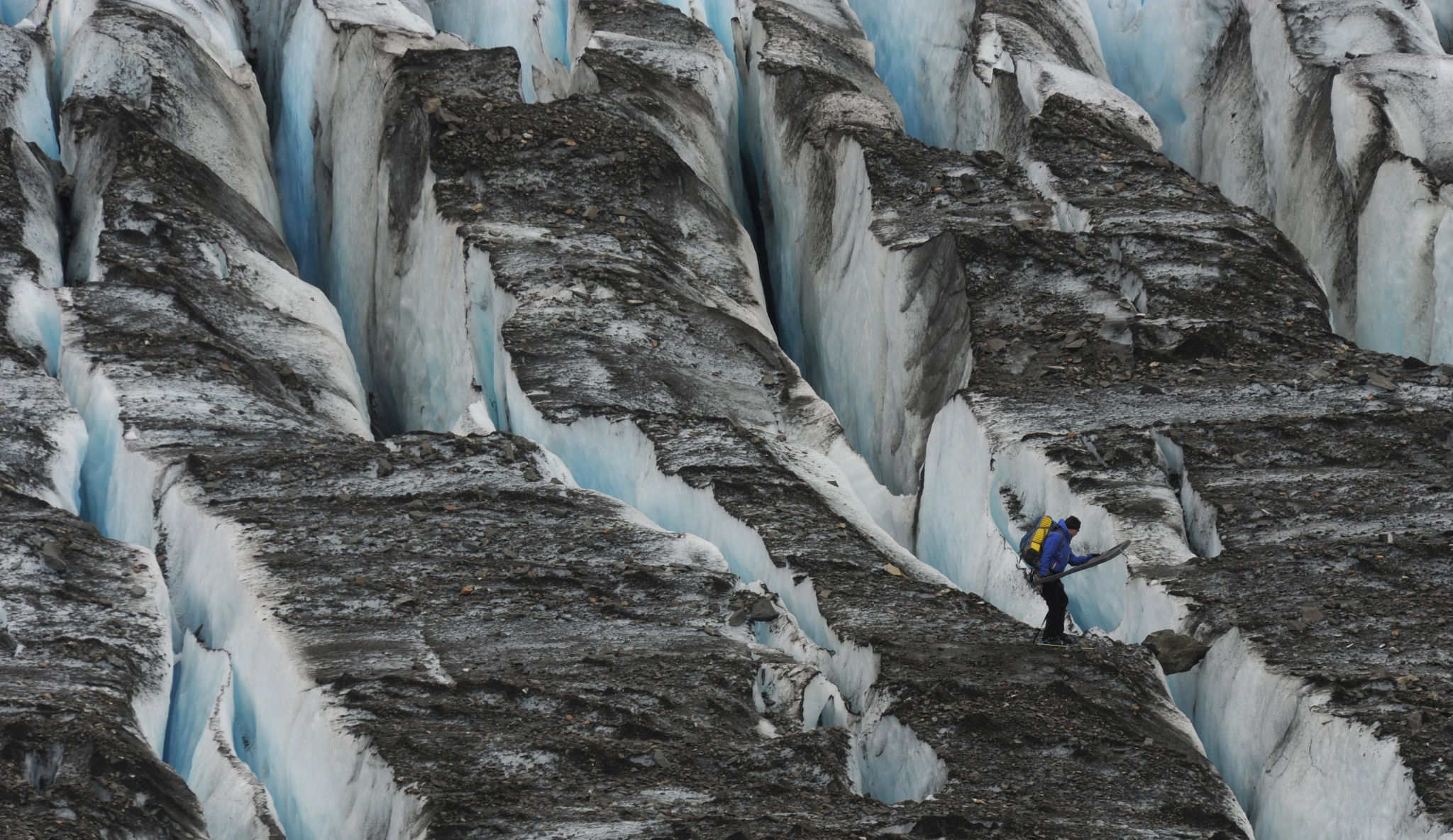
Fig 1: Dark layers of black carbon and mineral dust are visible within the ice of Mera Glacier in Nepal. NASA Goddard Space Flight Center. Photographer: Jesse Cunningham.
The Himalayas are often imagined as a world apart: towering white peaks, remote glaciers and seemingly untouched landscapes. From a distance, their snow-covered slopes appear far removed from the traffic, factories, brick kilns and burning fields of the plains below.
But the atmosphere does not recognise these geographical boundaries.
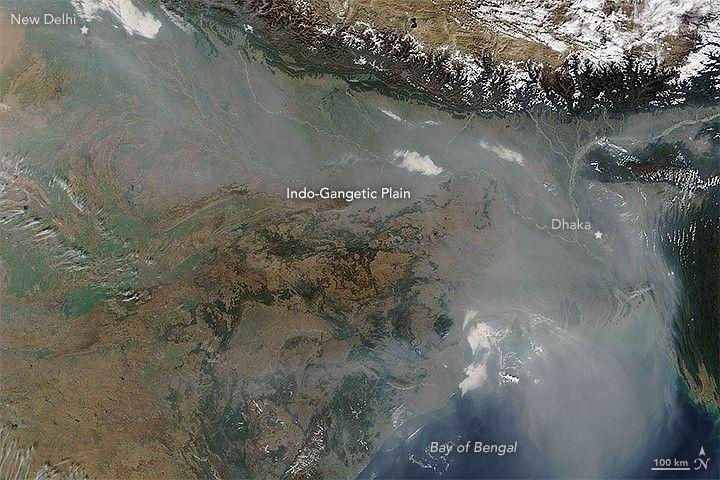
Fig 2: Satellite imagery reveals a broad haze layer over the Indo-Gangetic Plain, illustrating the scale of atmospheric pollution near the Himalayas. Source: Copernicus Sentinel 2, European Union
A particle released from a vehicle in a crowded city, a brick kiln in the Indo-Gangetic Plain or a field where agricultural residue is being burned can travel hundreds of kilometres. Some of these particles eventually reach the Himalayan mountains. When they settle on snow and ice, they can change how the surface interacts with sunlight, making it absorb more energy and melt faster.
This is one of the less visible connections between air pollution and climate change: pollution does not only affect the air we breathe. It can also influence the fate of snow and ice far beyond the places where it originates.
A journey from the plains to the mountains
Among the pollutants attracting particular scientific attention is black carbon, commonly known as soot.
Black carbon is produced when fuels and biomass do not burn completely. Sources include diesel engines, brick kilns, industrial combustion, traditional cooking stoves, forest fires and the burning of agricultural residues. Unlike carbon dioxide, which is a greenhouse gas that remains in the atmosphere for a long time, black carbon is a short-lived climate pollutant. It generally remains in the atmosphere for days to weeks, but during that time it can absorb sunlight and contribute to atmospheric warming.
So how does it reach the Himalayas?
The answer lies partly in atmospheric circulation and the region's complex geography.
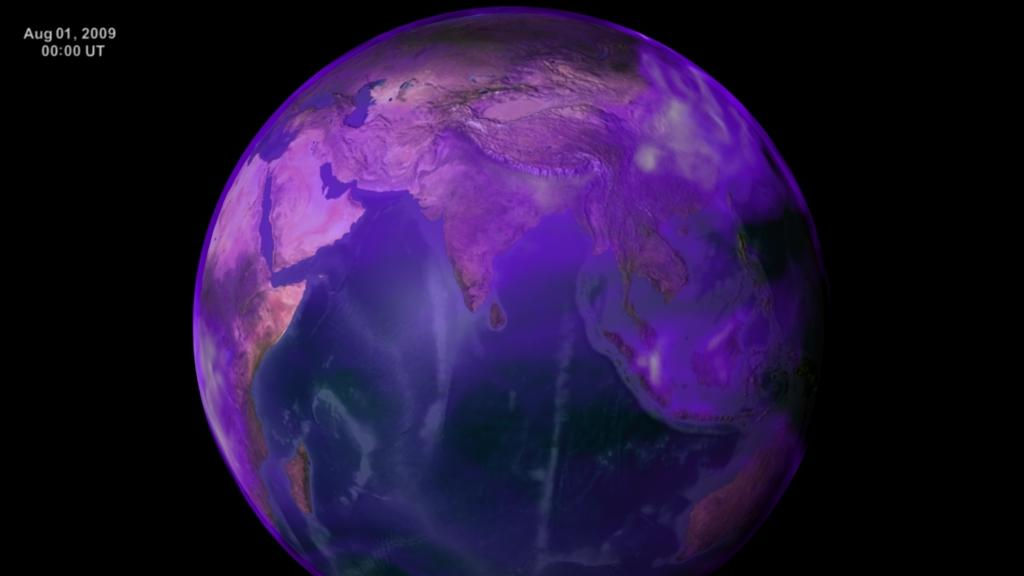
Fig 3: NASA's atmospheric model visualizes the movement of black-carbon pollution over the Indo-Gangetic Plain and surrounding Himalayan region. NASA Scientific Visualization Studio.
The Indo-Gangetic Plain is a major source region for atmospheric pollution in South Asia. During certain seasons, emissions from this densely populated region accumulate into layers of haze containing black carbon and other aerosols. Winds can carry these polluted air masses towards the Himalayan foothills and beyond.
Himalayan valleys also play an important role. Their distinctive wind systems can transport air from lower elevations towards higher mountain regions. This means that even remote valleys are not necessarily isolated from pollution produced far away.
A 2018 study published in Atmospheric Chemistry and Physics, titled Transport of Regional Pollutants through a Remote Trans-Himalayan Valley in Nepal, provided direct observational evidence of this process. Researchers monitored black carbon and ozone in the Kali Gandaki Valley between 2013 and 2015. They found that pollutant concentrations were higher during daytime, when winds flowing up the valley were dominant. The average speed of this up-valley flow was approximately 17 metres per second.
The researchers also found that black carbon concentrations peaked between March and May, before the summer monsoon, and that episodes of unusually high concentrations could persist for several days.
This finding matters because it demonstrates that the Himalayas are not simply receiving pollution from nearby settlements. Atmospheric pathways can connect distant emission sources with high-altitude environments.
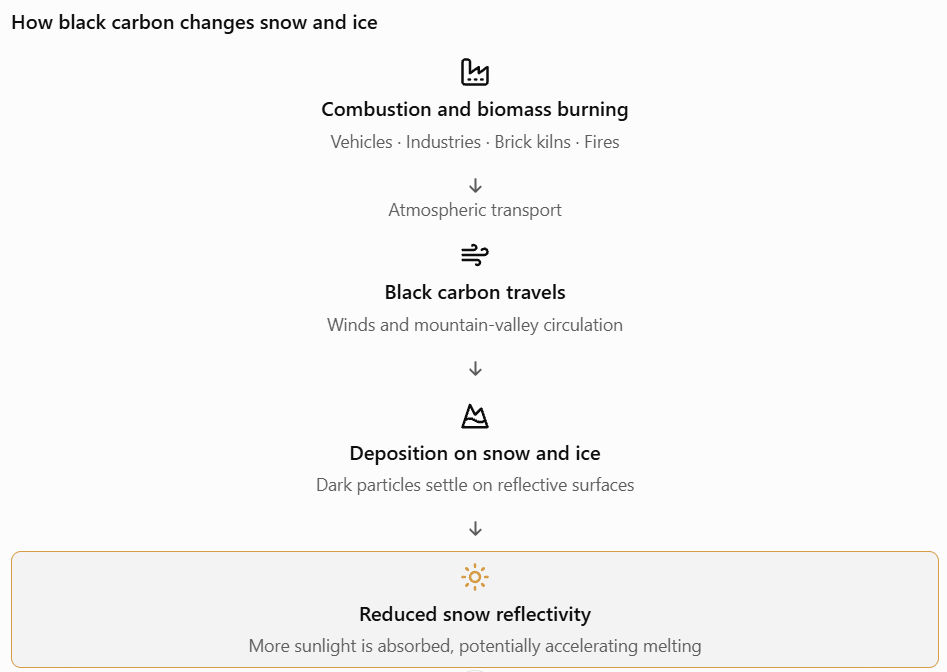
Fig 4:The journey of black carbon from emission sources to Himalayan snow, where deposited particles can reduce reflectivity and increase solar energy absorption.
What happens when black carbon lands on snow?
To understand why this pollution matters, we need to understand a basic property of snow: its ability to reflect sunlight.
Fresh snow is exceptionally reflective. A large proportion of the sunlight reaching its surface is reflected back into the atmosphere rather than absorbed. Scientists describe this property as albedo.
Black carbon changes that.
When tiny dark particles settle on snow, they reduce its reflectivity. Instead of reflecting as much incoming sunlight, the contaminated snow absorbs more solar energy. That additional energy contributes to warming and melting.
This process can also create a feedback effect. As snow melts, its grains become larger and the surface can become less reflective. More exposed ground, rocks or darker ice may absorb additional sunlight, further increasing local heating.
In other words, a relatively small amount of dark material can influence the energy balance of a much larger snow-covered surface.
And black carbon is not the only particle involved. Mineral dust can also darken snow and absorb sunlight. Dust may originate from dry landscapes, exposed soil and deserts, and can travel over considerable distances before being deposited on mountain snow.
A 2023 study published in Atmospheric Environment, using satellite lidar observations from 2006 to 2018, examined mineral dust over the Himalayas. It estimated that dust reduced snow albedo by approximately 0.3% on fresh snow and up to 2.7% on aged snow. The study also found that polluted dust made up a substantial proportion of the aerosol mixture over the region.
This is why the issue is broader than soot alone. Different light-absorbing particles can work together to change how much solar energy snow and ice absorb.
Scientists have found evidence in Nepal's own glaciers
Perhaps the most important evidence comes from measurements taken directly in the Himalayas.
In 2015, researchers published a study in The Cryosphere titled Black Carbon in Snow in the Upper Himalayan Khumbu Valley, Nepal. They collected snow samples in the upper Khumbu Valley between November 2009 and February 2012 and detected black carbon concentrations of up to 70 parts per billion.
The researchers then used a snowpack model to investigate how different black-carbon concentrations could affect snow reflectivity and melting. Under their modelled scenarios, the presence of 100 parts per billion of black carbon shifted the timing of seasonal snowmelt by approximately 3–10 days, while 300 parts per billion shifted it by 17–27 days across the three winter seasons examined.
These figures are model results, not measurements of how many days earlier every Himalayan glacier is now melting. But they demonstrate how deposited particles can influence the duration of seasonal snow cover under particular conditions.
More recently, a 2024 study published in Atmospheric Pollution Research, Measured Black Carbon Deposition over the Central Himalayan Glaciers, examined black-carbon deposition and snow samples from Nepal's Yala Glacier.
The researchers found that approximately 50% of the estimated annual dry deposition occurred during the pre-monsoon season, between March and May. Their analysis attributed 72% of annual black-carbon deposition to fossil-fuel sources and 28% to biomass burning. Snow measurements and radiative-transfer modelling indicated that black carbon could reduce surface snow albedo by up to 8.8% in the study area.
Another study, published in 2021, also investigated black-carbon concentrations and potential source contributions around Yala Glacier. It identified contributions from both biomass burning and fossil-fuel combustion, with Nepal and India together making the largest regional contribution in its source analysis.
The evidence is not limited to Nepal. A March 2026 study, Black Carbon Concentrations and Atmospheric Forcing in a High-Altitude Himalayan Valley, measured black carbon in Yumthang Valley in the Eastern Himalaya, at approximately 3,800 metres above sea level. Monthly average concentrations ranged from 1.04 micrograms per cubic metre in August to 9.55 micrograms per cubic metre in April. The researchers associated the higher pre-monsoon concentrations with regional biomass burning, long-range transport and fossil-fuel emissions.
Taken together, these studies reveal an important pattern: pollution reaches high-altitude Himalayan environments, accumulates in snow and varies considerably across seasons and locations. The problem is not simply that polluted air exists near the mountains. Its particles can become part of the mountain snowpack itself.
Why the season matters
The relationship between pollution and Himalayan snow is not constant throughout the year.
Research repeatedly identifies the pre-monsoon period as particularly important for black-carbon concentrations and deposition. During this time, agricultural burning, biomass combustion, fossil-fuel emissions and favourable atmospheric conditions can contribute to higher pollution levels. Snow-covered surfaces are also exposed to increasing solar radiation as the season progresses.
During the summer monsoon, the situation changes. Rainfall can remove aerosols from the atmosphere through a process known as wet deposition. This helps explain why several Himalayan monitoring studies report lower atmospheric black-carbon concentrations during monsoon months.
However, lower atmospheric concentrations do not mean that all previously deposited particles disappear immediately. The timing of deposition, snowfall, rainfall, snow accumulation and melting all influence how much pollution remains in the snowpack.
A 2024 Yala Glacier study, for example, estimated that annual accumulated wet deposition of black carbon was substantially greater than dry deposition. This highlights why precipitation is not simply a source of fresh snow: it is also an important mechanism through which atmospheric particles reach the surface.
The seasonal relationship is complex, but it reinforces the importance of monitoring both the atmosphere and the snow itself.
Does pollution explain why Himalayan glaciers are shrinking?
It is important not to confuse one contributing factor with the entire problem.
Himalayan glaciers are losing ice primarily in the context of long-term climate warming, alongside changes in snowfall, precipitation and other local environmental conditions. Rising temperatures influence glacier mass balance by increasing melting and changing the balance between snow accumulation and ice loss.
Black carbon and mineral dust add another pressure by altering the amount of solar energy absorbed by snow and ice. They can intensify melting under suitable conditions, but they do not explain glacier retreat on their own.
A 2016 review, Black Carbon and the Himalayan Cryosphere, highlighted significant uncertainties in estimates of black-carbon emissions, atmospheric concentrations and deposition across the Hindu Kush Himalaya. It also identified gaps in monitoring, particularly in areas where measurements were scarce.
These uncertainties matter. The Himalayas cover a vast and geographically diverse region. Pollution levels measured at one glacier cannot automatically represent every mountain range, valley or elevation. Researchers still need more long-term observations to understand how different pollutants interact with changing weather, snowfall and glacier conditions.
Yet uncertainty about the exact contribution does not mean the problem can be ignored. Measurements from Nepal's Khumbu and Yala regions already show that black carbon is reaching Himalayan snow and influencing its reflectivity.
The mountains are connected to the air we produce
The story of black carbon in Himalayan snow challenges the idea that air pollution is only a local problem.
The smoke released in one place can travel across administrative and national boundaries. The particles may eventually settle on mountains that appear distant from the activities responsible for producing them. Their effects can then become part of a much wider climate and environmental challenge.
Reducing black-carbon emissions therefore has benefits beyond improving the air people breathe. Cleaner combustion, more efficient brick kilns, reduced open burning, cleaner household energy and better transport systems can also reduce the amount of light-absorbing pollution entering the atmosphere.
The Himalayas cannot be protected by conservation efforts alone if the air surrounding them continues to carry pollutants from across the region. Addressing this challenge requires better monitoring, scientific collaboration and coordinated action across South Asia.
The next time we look at a photograph of a snow-covered Himalayan peak, it is worth remembering that the atmosphere connecting it to the rest of the world is not invisible in its consequences.
Some of the pollution released far below may eventually reach that snow. And even particles too small to see can change how much sunlight it reflects, how much heat it absorbs and how quickly it melts.
The Himalayas may stand above the pollution of the plains, but they are not beyond its reach.
References
Dhungel et al. (2018), Atmospheric Chemistry and Physics. Transport of regional pollutants through a remote trans-Himalayan valley in Nepal. Direct observations from the Kali Gandaki Valley. Read the paper.
acp.copernicus.org
Jacobi et al. (2015), The Cryosphere. Black carbon in snow in the upper Himalayan Khumbu Valley, Nepal: observations and modelling of impacts on snow albedo and melting. Read the paper.
tc.copernicus.org
Gul et al. (2024), Atmospheric Pollution Research. Measured black carbon deposition over the central Himalayan glaciers, including Yala Glacier. Read the study record.
lib.icimod.org
Gupta et al. (2026), Environmental Research Communications. Black carbon concentrations and atmospheric forcing in a high-altitude Himalayan valley, based on measurements in Yumthang Valley. Read the paper.
DOI
Sharma et al. (2021), Environmental Pollution. Black carbon concentration in the central Himalayas: impact on glacier melt and potential source contribution. Read the research record.
PubMed
Rana et al. (2023), Science of the Total Environment. Variability of ambient black carbon concentration in the Central Himalaya and its assessment over the Hindu Kush Himalayan region. Read the paper.
ScienceDirect
Skiles et al. (2018), Nature Climate Change. Radiative forcing by light-absorbing particles in snow. A broader review of the science behind snow darkening. Read the review.
Nature
ICIMOD. Air quality in the Hindu Kush Himalaya, including the role of monsoon and winter westerlies in transporting pollutants. Read ICIMOD's overview.
ICIMOD
Mineral dust aerosols over the Himalayas (2023), Atmospheric Environment. Satellite lidar assessment of dust and its effect on snow albedo. Read the study.
ScienceDirect
Bond et al. (2013), Journal of Geophysical Research: Atmospheres. Bounding the role of black carbon in the climate system, a foundational assessment of black-carbon sources and climate effects. Read the paper