

A large part of the climate crisis discourse focuses on how climate change affects our environment. We hear about rising temperatures, changing rainfall patterns, and rising impacts of natural disasters every day. There is abundant scientific research about climate change impacts on Nepal’s various ecosystems. But one thing is often missing: simple, actionable solutions that communities can implement together. Even though we talk about climate impacts, we rarely talk about the people who are suffering the most- the rural communities who have no facilities, minimal support, and suppressed voices. There are still many places in Nepal where we do not even know what the people’s struggle looks like.
Rural Women: Carrying the Weight of Climate Change
Nepali women, especially in rural areas, are more vulnerable to climate change. While their husbands migrate for work, women carry the full responsibility of their families and depend on agriculture for food and income. However, climate change is shifting the rainfall patterns - sometimes too late, sometimes too heavy, and farmers feel this change in every harvest. Because of this, they cannot grow enough food for their families which reduce crop yields, making them economically weaker and emotionally stressed. Even today, in many rural places, women walk long distances to collect water from streams and travel far to gather firewood. Climate change makes these tasks even harder as water sources dry up and forests become thinner.
Women’s Daily Lives in a Changing Climate
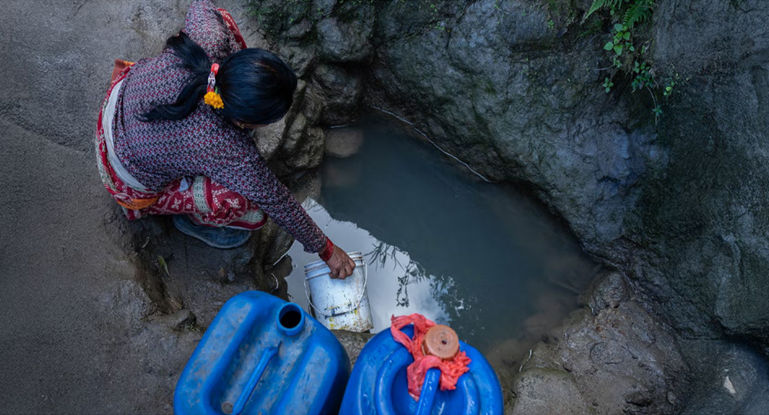
This figure represents the daily struggle of many rural Nepali women living with the impacts of climate change. I come from a small rural village in Nepal where life depends on farming, and I have witnessed that most women carry the main responsibilities both at home and in the fields. This makes the effects of climate change even more visible in their everyday lives. Women work from early morning to evening planting, weeding, harvesting, and caring for livestock yet they rarely have access to their finance . The land is usually not in their name, so they cannot take loans or receive financial support when crops fail. When the rain comes too late or too heavy, they have no backup. Their income drops, their food sources become uncertain, and their daily life becomes even more challenging. Streams are drying and firewood is becoming scarce, forcing rural women to walk farther and work longer each day. This is a quiet but heavy reminder of how climate change reshapes people’s lives in ways that often go unnoticed.
Why Are Rural Communities Still Left Behind?
Many rural areas still lack access to climate information, financial resources, training on climate‑smart farming, and even basic facilities like water, irrigation, or clean energy. Because of these gaps, rural communities are often left out of climate conversations, even though they carry the heaviest and most immediate impacts on their shoulders.
what can we do together?
Instead of blaming or relying only on scientific language, we can begin with simple, practical actions that communities can do together. In many villages, mothers’ groups (aama samuha), youth clubs, and schools already meet regularly these spaces can easily become places to share local knowledge, teach small climate practices, and support each other. Communities can also strengthen climate‑smart farming by promoting composting, saving local seeds, growing kitchen gardens, and choosing drought‑resistant crops. These are not big or expensive solutions; they are small steps that make a meaningful difference in daily life.
A future built on togetherness means starting with the basics by listening to rural women, understanding their daily struggles, supporting one another, and working as a community. When people come together, even small actions protecting soil, saving water, planting trees, or managing resources can help safeguard land, water, and families. Climate change is a huge challenge, but the path forward does not always need to be complicated. Often, it begins with simple acts of care and cooperation.
Case Study: Women of Dhankuta Restoring Drying Springs
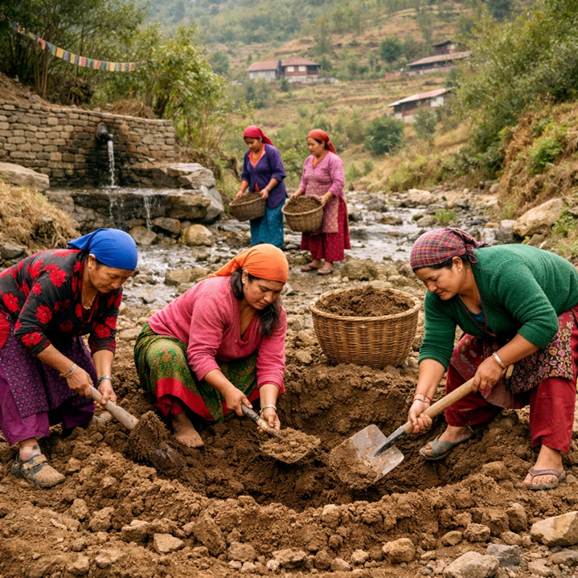
In the hill communities of Dhankuta, water scarcity has become one of the most urgent climate challenges. Springs that once flowed year‑round have begun to dry up due to erratic rainfall, longer dry seasons, and declining groundwater recharge. For women who were traditionally responsible for collecting water, this meant walking long distances every day, often spending hours just to bring home a few litres. In response, women from local mother’s group (aama samuha) and water‑user groups led community‑based spring‑restoration efforts. With technical guidance from ICIMOD, they mapped drying springs, dug recharge pits, planted water‑retaining grasses, and built small stone bunds to slow monsoon runoff so that rainwater could seep back into the ground (Gurung and Bisht, 2014). They also cleaned and repaired traditional dhunge dharas (stone spouts) and created fair‑use schedules to ensure every household received enough water. As a result, several springs began flowing more reliably again, reducing women’s daily labour, and strengthening community resilience. Their leadership showed how women were at the frontline of climate adaptation in Nepal’s mid‑hills.
Nepal’s climate future becomes stronger when rural voices are truly heard especially the voices of women who live closest to the land. When we listen to women, we learn things that data alone cannot show. Women notice which springs are drying first, which seeds survive drought, which forests are thinning, and which families are struggling silently. Their knowledge comes from daily experience, not from reports, and that makes it deeply valuable.
Moreover, listening to women also brings practical solutions. In many villages, women are already leading small but powerful changes: saving drought‑resistant seeds, managing community firewood, protecting water sources, and teaching children how to care for the land. These actions may look simply, but they build resilience that keeps families and communities strong. When women are recognized not just as victims of climate change, but as leaders of resilience, the whole community benefits. Their ideas are grounded, their leadership is collective, and their solutions are rooted in care. Nepal’s climate future will be more just, more sustainable, and more hopeful when women’s voices guide the way.
Nepal’s climate future becomes stronger when rural voices are truly heard especially the voices of women who live closest to the land. Their daily experiences show what data alone cannot capture which springs dry first, which seeds survive drought, which forests are thinning, and which families are struggling silently. When women lead, communities find solutions that are practical, rooted in care, and shaped by real life. Across Nepal, women are already restoring water sources, saving drought‑resistant seeds, protecting forests, and teaching children how to care for the land. These actions may look small, but they build resilience that keeps families and communities strong. Climate change is a global challenge, but hope grows from these quiet, local efforts. Therefore, sustainable, and hopeful future is possible when women’s knowledge guides the way and when we work together without leaving anyone behind.
References
Gurung, D.D. and Bisht, S. (2014) ‘Women’s Empowerment at the Frontline of Adaptation : Emerging Issues, Adaptive Practices, and Priorities in Nepal - ICIMOD Working Paper 2014/3 (2014)’, p. 84. Available at: http://lib.icimod.org/record/29811.
UN WOMEN (2025) Centring women’s knowledge and leadership in Nepal’s climate response. Available at: https://asiapacific.unwomen.org/en/stories/feature-story/2025/06/centring-womens-knowledge-and-leadership-in-nepal.