

In the remote mountains of western Nepal, Tara Pariyar's story reveals a hard truth: subsistence farming is fragile. Once a widow struggling to provide even two meals a day for her family, Tara lived on the brink of crisis. A single drought, an unexpected frost, a failed harvest, any of these could devastate everything. But through climate-smart agriculture supported by the World Food Programme and the Government of Nepal, she found a different path, one that's now reaching 66,000 people across the region.
Tara shifted from subsistence farming to growing apples as her primary cash crop, supplemented by tomatoes, onions, walnuts, and poultry and rabbit farming. She adopted climate-smart practices, including drip irrigation and improved water management, received climate-resilient apple saplings bred to withstand stress, and joined marketing cooperatives that opened doors to buyers in Kathmandu willing to pay premium prices. Most critically, weather-based crop insurance, with the government covering 80 percent of premiums, gave her a safety net. Today, earning nearly US$700 annually from apples alone, Tara affords her children's education, buys nutritious food and medicines regularly, and reinvests profits into her diversified farm.
But what exactly changed? The answer lies in understanding agricultural resilience. Picture two farms: one is a glass vase, elegant but fragile. A single shock shatters it, leaving families without food or income. The other is a rubber ball. Designed to absorb impact, it bounces back. Even after climate-related setbacks, it continues producing food, supporting livelihoods, and contributing to the local economy. This is resilience, not the absence of shocks, but the ability to anticipate, withstand, recover from, and adapt to them. Tara's transformation from glass vase to rubber ball is precisely what agricultural resilience looks like.
Why Agriculture Resilience Matters
Agricultural Resilience is not simply an environmental concern; it is essential for Nepal’s food security, economic stability, and rural livelihoods. Agriculture here has always been weather-dependent, but climate change is making that dependency increasingly dangerous. Nearly 65% of Nepal’s cultivable land is rainfed, while only about 24% of arable land is irrigated, primarily in the Terai (Kattel & Nepal, 2021). This means that when monsoon rains arrive late, end early, or become erratic, farmers have little protection against crop losses.
The numbers tell a sobering story. Climate-related shocks already account for 18% of Nepal's annual economic losses in the agricultural sector (Maharjan et al., 2026). The Asian Development Bank report estimates that climate change will reduce Nepal's GDP by 2.2 per cent per year by 2050 (ADB, 2021). And recent years have made this threat starkly real. In September 2024, extreme rainfall, floods, and landslides caused agricultural losses exceeding NPR 3.55 billion, including more than NPR 3 billion in crop damage, according to the Ministry of Agriculture and Livestock Development. Less than a year later, in July 2025, Madhesh Province was declared a drought-affected area after prolonged dry conditions led to delayed planting, crop failures, and severe stress in vegetable and rice crops. The drought was estimated to reduce national rice production by up to 450,000 metric tons, nearly 10% of Nepal’s annual supply (Shrestha et al., 2025). Meanwhile, in mountain regions, the drying of springs and local water sources has further intensified water stress, making irrigation increasingly difficult.
This is the context in which agricultural resilience becomes not a luxury, but a necessity. By adopting practices such as crop diversification, agroforestry, improved water management, and climate-resilient crop varieties, farmers can better withstand climate shocks, protect their livelihoods, and ensure that Nepal’s agricultural systems remain productive in an increasingly uncertain future. The Green Resilient Agricultural Productive Ecosystems (GRAPE) project, led by ICIMOD, has tested over 40 climate-resilient agricultural technologies across Nepal's Karnali and Sudurpashchim provinces, engaging more than 2,500 smallholder farmers, the majority women who have witnessed firsthand how these strategies work (Thomas et al., 2024).
Traditional Farming and the Roots of Resilience
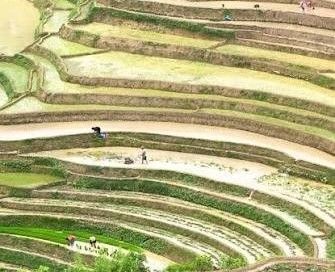
Long before climate adaptation became a global priority, Nepalese farmers were already living it, not as a strategy but as instinct. You can see it in the terraces that staircase down every hillside, in the irrigation canals communities have tended for centuries, in the quiet habit of saving the best seeds from each harvest before winter comes.
Nepal does not let its farmers be complacent. The land shifts too dramatically for that, the tropical valleys giving way to alpine ridgelines within a few hours of walking, monsoons arriving heavy one year and thin the next. To farm here has always meant living with uncertainty, and so, over generations, communities learned to make uncertainty livable.
They cut terraces into near-vertical slopes, not just to create farmable land, but to slow the monsoon’s rush, hold soil in place, and keep what took decades to build from washing into the river below. They dug kulos, hand-carved canals that carried water from mountain streams to fields far below, and maintained them collectively, deciding together where water flowed, who worked on repairs, and how it was shared in a dry years. A kulo was never just a canal. It was a community holding itself accountable to each other and to the land.
Multi-cropping, the practice of growing two or more crops on the same land simultaneously, quietly transforms how Nepali farmers approach agriculture, turning limited land into multiple income streams. The crops are diverse, such as millet beside legumes, maize alongside beans, and mustard threaded between other crops. Not out of indecision, but out of wisdom, because a field with many crops is far harder to break than a field with one. When frost took one crop or pests found another, something always remained.
In the fields of Makpa, Aiselukharka rural municipality-7, commercial farmers have discovered how to grow more from the same land. As their cabbage reaches maturity, they're already sowing maize seeds in the same field, a practice that allows them to harvest multiple crops from a single season and piece of land. In Kailali, farmer Sher Bahadur Saud earned approximately Rs. 60,000 in additional income by growing maize and mustard on just one bigha of banana plantation, income that wouldn't exist under traditional monocropping. By sowing maize, mustard, chili, and ginger in the spaces between plants, farmers are essentially harvesting two crops where there was one before. The practice addresses three pressing challenges at once: land scarcity, price volatility, and crop failure risk.
Farmers also kept the forest close, not just for timber or fodder, but because they understood, without any formal vocabulary for it, that trees cool the air, anchor the soil, and hold moisture long after the rain has passed. They understood, through centuries of observation, what we are only now learning to measure: that resilience is not built alone, and it is not built in a season. It is built through relationships with the land, with water, with people, and with the slow accumulation of knowledge that only comes from paying close attention over many years.
But, somewhere in the latter half of the twentieth century, that loop began to break. As the Green Revolution reached Nepal’s valleys and plains, farming shifted, slowly at first, then all at once, toward something that looked like progress but carried hidden costs. Diverse fields gave way to monocultures. Local landraces were replaced by high-yielding varieties dependent on chemical inputs. Soils lost their depth as synthetic fertilizers replaced manure. The social fabric, too, began to fray, the collective labor that once kept the kulos flowing, the shared knowledge of the community forests, quietly dissolving.
The Path to a Resilient Future
The answers Nepal needs are not waiting to be invented. They are already here in the hands of the farmer who still rotates their crops by instinct, in the community that still clears its kulo together before the monsoon, in the seed saved and wrapped in cloth and stored through the winter. What remains is not discovery, but decision, whether we choose to build the systems that support what farmers already know, rather than replace it with something that only looks like progress.
That means better access to climate-resilient seeds and fair markets for diverse crops. It means water infrastructure that treats communities as partners, not just beneficiaries. It means an agricultural policy that listens before it prescribes, especially to the women who, in much of rural Nepal, do the farming. The rubber ball was never lost. It was just undervalued. And in a world where the shocks are coming faster and harder, that may be the most important thing Nepal's agriculture story has to teach not only to its own farmers, but to anyone paying attention.