

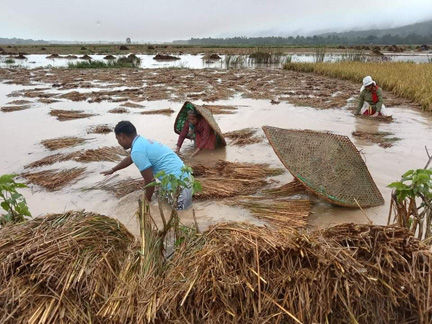
In July 2025, farmers in Nepal’s Madhesh Province waited for monsoon rains that did not arrive on time. ICIMOD (2025) reported that by late July only about 52% of the province’s paddy fields had been transplanted, compared with 92% at the same point the year before, and on 23 July the federal government declared the entire province drought-affected. Then the rain came at the wrong moment. Heavy downpours in October flooded fields where paddy was ready for harvest or already cut and left to dry, and the agriculture ministry estimated losses of around Rs 3.5 billion from the early October rains alone (Prasain, 2025). The same season brought both too little water and too much, and in between, farmers lost a year of work.
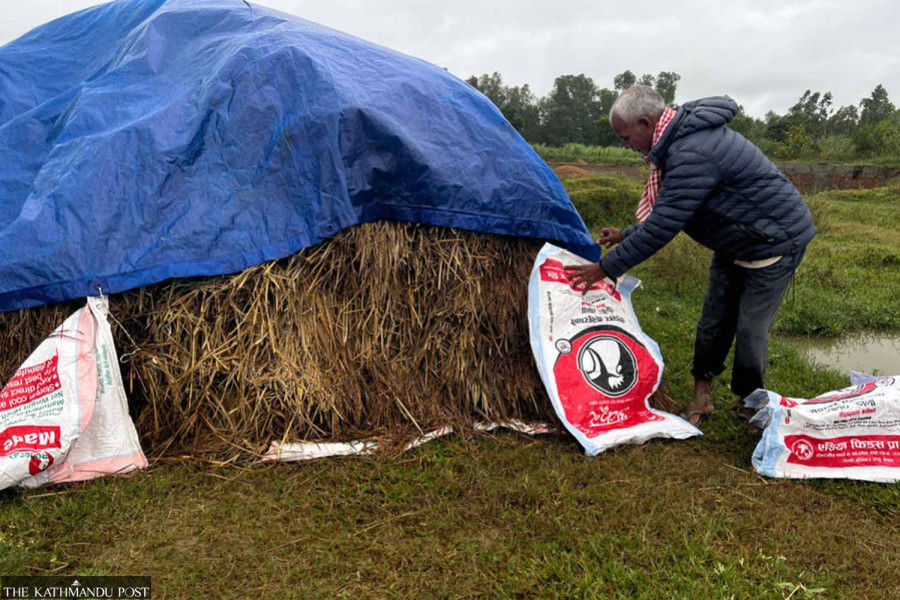
In Mahottari, Awad Kishor Mahato was among the farmers shielding their paddy with tarpaulins as the rain returned. Farmers told the Kathmandu Post that this pattern, drought at planting and rain at harvest, has repeated in recent years. “At this rate, we may not even have enough to feed our family,” Mahato said (Post Report, 2025). Across Jumla, Mahottari, Ramechhap, Salyan, and Kapilvastu, the rains flattened ripe paddy and soaked harvested crops, causing sprouting and rot.
Why the Calendar Is Breaking
Nepal is warming faster than the global average. The Department of Hydrology and Meteorology (DHM) has recorded a rise in average annual maximum temperature of about 0.056°C per year, roughly 2.2°C over four decades. That matters because only about 44.6% of Nepal’s agricultural land is irrigated, so more than half of the country’s farmland depends mainly on the monsoon.
For a rain-fed farmer, total rainfall is not the whole story. The timing, intensity, and distribution of rainfall matter just as much. A season may receive substantial rainfall overall yet experience drought during planting or flowering, while intense rainfall over a few days can cause flooding, soil erosion, and crop destruction. FAO (2026) linked the 2025 paddy decline to rainfall deficits in June and July.
Not Every Field Feels It the Same Way
Each crop grows best within an optimal temperature range, and temperatures outside it interfere with germination, flowering, pollination, and grain formation. Research from the Koshi River basin shows that warming affects crops differently depending on elevation. Rice, maize, and wheat cultivated in warmer, lower-altitude areas are more likely to suffer heat stress during flowering and grain formation. At some higher elevations, a little extra warmth has helped yields, provided water and soil fertility hold up.
What Is Already Working
I am seeing the same lesson again this year. Rain has returned in late October 2026, just as paddy is ready for harvest. Forecasters advised farmers to hold off harvesting during those days, and those who listened saved their paddy. My own family was one of them: we followed the forecast and did not harvest.
The same was true in October 2025. An agricultural economist in Manthali Municipality told the Kathmandu Post that farmers who followed weather updates protected their paddy, while those without that information suffered losses (Post Report, 2025). The difference between a harvest and a loss was sometimes a forecast reaching farmers in time. To be useful, early warnings must arrive through mobile phones, radio, extension workers, and local governments, with practical advice attached, in Nepali and local languages.
Farmers are also adapting on their own. In Kailali, one of Nepal’s most flood-prone districts, farmers have started transplanting spring paddy as early as March so it can be harvested before the rivers rise. Sitaram Dagoura, who began the practice nearly two decades ago, was ridiculed at first for planting paddy in the wrong month (BC, 2026). Agricultural officials caution that spring paddy is mostly grown where monsoon paddy fails, and farmers still lack affordable drying machines and timely access to improved seed, but it is a local solution, not a universal one.
Other adaptations need the same caution. Drought-, heat-, and flood-tolerant varieties matter, but they must be field-tested and supported with suitable planting dates, soil management, and irrigation. Direct-seeded rice and the System of Rice Intensification have shown promise (Devkota et al., 2019). Still, neither guarantees higher yields nor lower water use everywhere, because results depend on soil, weeds, labour, and farmers knowledge. Millet and buckwheat can diversify risk, but being traditional does not make a crop resilient, so each must be judged against future temperatures, rainfall, soils, and markets.
Conclusion
Nepal’s farmers have always read the sky, but the sky no longer keeps the old calendar. In 2025, a forecast that arrived in time was the difference between a harvest and a loss, and this October my own family saw the same. Better seeds and new methods will help, but none of it matters if the warning reaches the field after the rain does. The question is no longer whether the weather is changing. It is whether our support can move as fast as the rain.
References
Bhatt, D., Maskey, S., Babel, M. S., Uhlenbrook, S., & Prasad, K. C. (2014). Climate trends and impacts on crop production in the Koshi River basin of Nepal. Regional Environmental Change, 14(4), 1291-1301.
BC, R. (2026, May 5). Flood-prone farmers in Kailali turn to spring paddy to secure livelihoods. The Kathmandu Post.
Devkota, M., Devkota, K. P., Acharya, S., & McDonald, A. J. (2019). Increasing profitability, yields and yield stability through sustainable crop establishment practices in the rice-wheat systems of Nepal. Agricultural Systems, 173, 414-423.
Food and Agriculture Organization of the United Nations. (2026). GIEWS country brief: Nepal. Global Information and Early Warning System on Food and Agriculture.
International Centre for Integrated Mountain Development. (2025). 2025 drought in Nepal’s Madhesh Province: A rapid situational analysis. ICIMOD.
Prasain, S. (2025, November 5). Drought at planting, deluge at harvest leave farmers reeling. The Kathmandu Post.