


Imagine the Earth had a dashboard of vital signs the way a hospital monitor tracks a patient's heart rate, blood pressure, and oxygen levels. Each reading has a healthy range. Stay within it, and the body copes fine with everyday stress, but if you push past it, the body starts to destabilize gradually, or sometimes even all at once. Scientists now argue that Earth has a dashboard like this too, and it's called the planetary boundaries framework, comprising nine vital signs that indicate the status of planetary health. Unfortunately, yet unsurprisingly, the latest reading does not bode well; it stated that as of 2025, seven of Earth's nine vital signs are flashing red (1).
However, knowing that the planet has crossed these boundaries is only half of the story. The harder questions pertain to who gets to decide where those lines are drawn in the first place, and who pays the price when they’re crossed.
Part 1: What are the Planetary Boundaries?
For over 11,000 years, the Earth has existed in a geological era called the Holocene, which is characterised by unusual calm. This calm is regarding the climate: before the Holocene, the average temperatures of the Earth swung frequently between +4 degree Celsius and -4 degree Celsius. But with the advent of the Holocene, global temperatures barely wavered, drifting by only about half a degree Celsius (2). This led to rainfall patterns becoming predictable and nutrient cycles like that of nitrogen and phosphorus attaining a steady rhythm. Such situations cultivated the preconditions necessary for humans to settle, farm the same land season after season, and eventually build cities, economies, and civilizations.
However, in recent years, humanity has been taking such stability for granted, for that stability is now negatively impacted by anthropogenic activities, leading to the start of an era which some scientists and researchers now call the Anthropocene. The Anthropocene is defined by the fact that human activity, not natural cycles, is now the dominant force reshaping the planet. Global temperatures already sit 1.2°C above pre-industrial levels, the warmest Earth has been in 100,000 years (2). The predictable Holocene “window” has cracked open, and what's rushing in is a planet whose reactions we can no longer take for granted: deadlier heatwaves, fiercer floods, and forests that used to store carbon now releasing it instead.
Planetary boundaries are science's attempt to answer a practical question inside this new reality: how far can we push Earth's systems before we risk kicking off changes we can't undo?(3)
The nine boundaries
Researchers have identified nine Earth systems that together regulate the stability we depend on (2):
Climate change: tracked through rising CO₂ and the planet's changing energy balance
Stratospheric ozone depletion: the shield that blocks harmful UV radiation
Atmospheric aerosol loading: fine particle pollution that can disrupt monsoon rainfall
Biosphere integrity: species extinction rates and how much of Earth's biological productivity humans have taken for ourselves
Land-system change: how much forest and natural land has been converted for human use
Modification of biogeochemical flows: how much nitrogen and phosphorus we've pulled out of natural cycles, mostly for fertilizer
Introduction of novel entities: plastics, synthetic chemicals, and other human-made substances now circulating through the environment
Freshwater change: disruption to rivers, groundwater, and soil moisture
Ocean acidification: changing ocean chemistry as seawater absorbs excess CO₂
Of these nine planetary boundaries, seven have already been transgressed (1). This figure comes from the 2025 Planetary Health Check, and it's climbed steadily as monitoring has improved and pressure has intensified – from three transgressed boundaries in the original 2009 assessment (3), to four in 2015, to six in 2023 (4), and now seven, with ocean acidification the newest addition to the list (1). The only two boundaries which remain under safe limits are those of ozone depletion and aerosol loading, and even those show regional trouble spots (1).
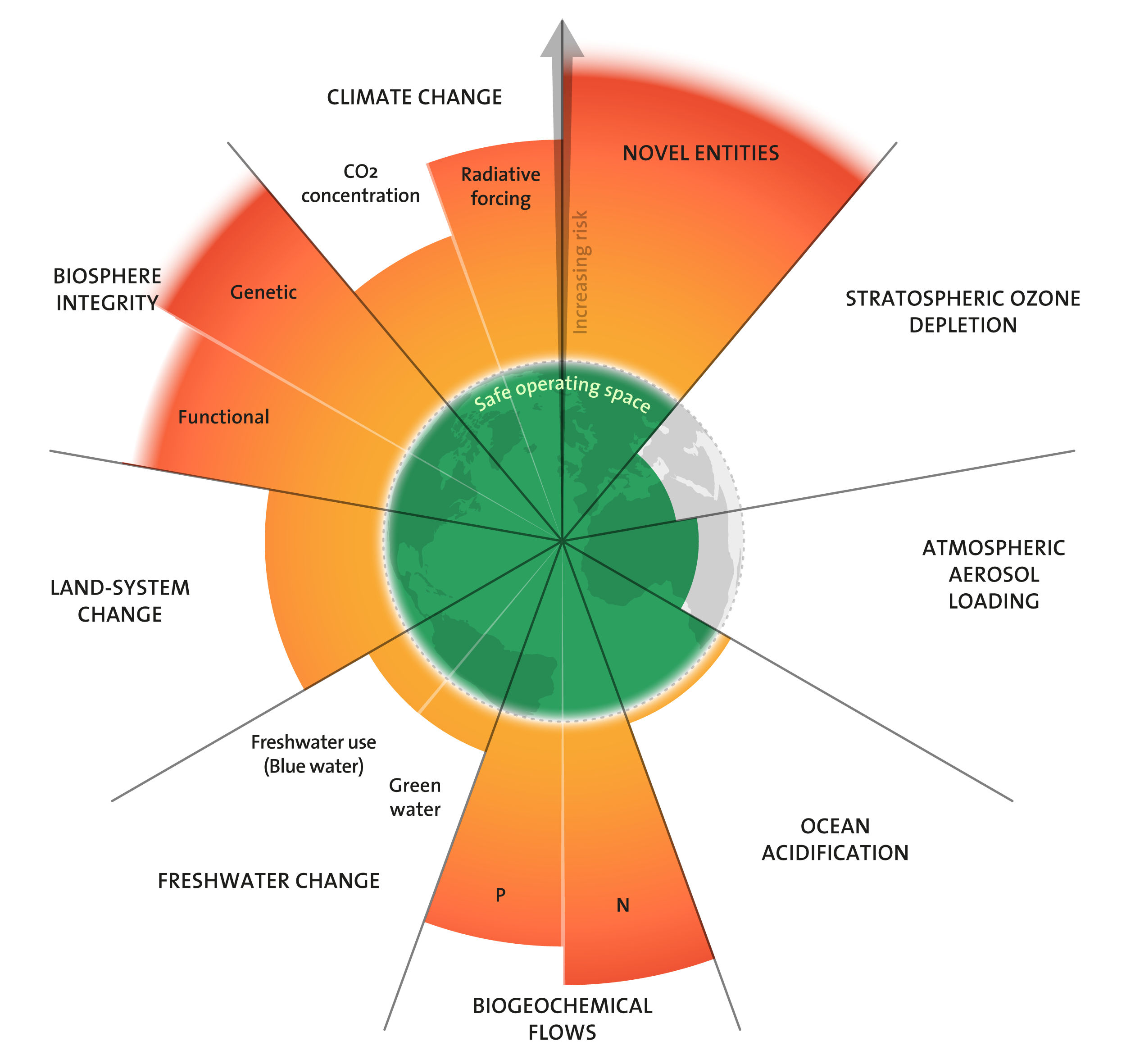
Of these nine, the boundaries of climate change and biosphere integrity are considered to be “core” boundaries, which means that the transgression of these two alone has the potential to destabilise the whole Earth system (2,4). Biosphere integrity is described as “unravelling,” as extinction rates are now estimated at 100 to 1,000 times natural background levels (1). Climate change sits in what scientists call the danger zone, with a key measure of the planet's energy imbalance now roughly double the high-risk threshold (1).
This being said, the nine boundaries aren't separate dials, but are wired together (2,4). Take one concrete chain of cause and effect: farms worldwide apply nitrogen and phosphorus fertilizer at rates far beyond what crops can absorb. The excess washes into rivers, and this runoff is then carried into oceans, triggering explosive algae growth. When that algae dies and decomposes, it strips the water of oxygen and creates “dead zones,” (1,2) where marine life simply cannot survive. That's the biogeochemical flows boundary directly eroding the biosphere integrity boundary. And weakened ocean ecosystems are less able to absorb CO₂, feeding back into the climate boundary too.
This is where the conversation on tipping points comes in, which are essentially thresholds where a system stops responding gradually and instead flips into a new, often irreversible state when boundaries are transgressed, usually through a self-reinforcing feedback loop (1). The melting of Arctic ice is a classic example: less white ice means more dark ocean water is exposed, which absorbs more heat, which then melts more ice (1). The Amazon rainforest, the Greenland ice sheet, and the Atlantic Ocean's circulation system are all considered live candidates for this kind of abrupt, cascading shift, and crossing one can lower the threshold for the others (1,2).
Why this is not abstract
The consequences aren't confined to distant ecosystems or future decades, they're already showing up in food, water, and safety. Unhealthy food, much of it a byproduct of the very agricultural systems driving boundary transgressions, is now the single largest cause of premature death globally (around 11 million lives a year) (2). More than a fifth of the world's land area already shows serious deviations in water availability, with major basins like the Indo-Gangetic Plain already past safe limits (1). In 2024 alone, extreme weather events caused widespread loss of life and damage on a scale without precedent (1).
Scientists are blunt about the timeline: the window for returning to a safe operating space, they warn, is closing fast.
Part 2: The Politics of Whose Limits
To add another layer to this already complex and alarming yet uncontested scientific conversation we should ask ourselves, “what should we do about this?” The answer to this question would depend very much on where you’re standing on the planet.
Who decided what ‘safe’ means?
The planetary boundaries framework was built by scientists for a scientific purpose: identifying biophysical thresholds. But the moment those thresholds get used to argue for global policy, such as telling countries how much they can emit, extract, or develop, they stop being purely scientific and become political (5,6). Here is where critics start asking uncomfortable questions.
There are several reasons as to why the planetary boundaries framework doesn’t sit right with several people. Most prominent is the fact that the 29 scholars who originally developed the framework back in 2009 are almost all men, almost all natural scientists, and almost all based in wealthy OECD countries; not a single scholar from the Global South was part of that founding group (3,5). Critics describe the resulting framework as having an “astronaut's eye view” – managing Earth like a machine to be monitored from orbit, while ignoring the local and regional realities that people actually live through long before any global threshold is crossed (6). Additionally, critics also point to the fact that presenting these thresholds as neutral scientific facts rather than political choices actually depoliticizes them and quietly removes questions of power, fairness, and historical responsibility from the table before the conversation even starts (5,6).
This is where some scholars bring another additional lens entirely and argue that today’s ecological instability isn't a neutral accident of industrial progress, but a direct continuation of colonial history (7).
Colonialism was, among several other things, driven by and spread the idea that “civilization” meant mastering and extracting from nature, by stripping land of any spiritual or intrinsic value, and treating it purely as a resource (7). Western industrial wealth was built on centuries of extracting fossil fuels and raw materials from colonized regions, through forced labour, enclosure of common lands, and the plantation systems that reshaped ecosystems across the Global South (7,6). That legacy didn't end with independence, and is still very much a present day reality (8). Scholars point to unequal ecological exchange – a pattern where wealthy nations continue to import land, labour, and biomass embedded in the products they consume, effectively offshoring their environmental footprint onto the South (8,9). This is reflected through the fact that roughly 90% of the excess carbon currently in the atmosphere originated in the advanced industrial economies of the West (7,10). In other words, the Global South inherited a depleted carbon budget and a destabilized climate it did almost nothing to create.
The numbers behind the inequality
This is also reflected through data: the poorest countries in the world with around half of the world’s population experience more than 60% of global social shortfalls such as inadequate healthcare, electricity, housing, while contributing a mere 4% of humanity's annual ecological overshoot. On the other hand, the riches nations are responsible for more than 40% of that overshoot while accounting for only 2% of the social shortfall (10).
Communities across the Global South have organized in direct response to this imbalance on several occasions. In India's Himalayan foothills, threats to local livelihoods sparked the landmark Chipko movement, and courts have since granted legal personhood to rivers and glaciers (7). In the Ecuadorian Amazon, the Kichwa people of Sarayaku have led sustained resistance to oil extraction to protect what they call the “living forest.” In Nigeria, campaigns have pushed to leave oil in the ground rather than extract it (6). These aren't isolated protests, but are part of a pattern of communities defending ecosystems that global frameworks were never designed to protect.
Reimagining what ‘safe’ could mean
None of this means the Global South rejects the idea of limits, quite the opposite actually. Many of the alternative frameworks emerging from this critique take planetary boundaries seriously while insisting equity has to be built in from the start, not added later (9).
‘Doughnut economics’ is probably the most well-known attempt at this, combining the ecological ceiling of planetary boundaries with a social foundation, such as minimum standards for food, health, housing, and political voice, to define a space that's both ecologically safe and socially just (10).
‘Degrowth’ proposals call for wealthy, high-consuming nations to deliberately scale down their resource use, freeing up ecological space for countries with genuine, unmet development needs to grow (8,9).
The principle of common but differentiated responsibilities, long used in climate negotiations, insists that nations with the greatest historical responsibility must lead on cutting emissions and fund the transition for those who didn't cause the problem (7).
Beyond these policy frameworks, scholars also bring to light entirely different worldviews that predate and challenge the Western growth model altogether, such as the South American Buen Vivir (living in harmony and plenitude rather than accumulation), the Gandhian concept of Swaraj (self-rule rooted in community autonomy), and Southern African Ubuntu (humanness defined through relationship, not separation from nature or each other) (6). The ‘Rights of Nature’ movement goes further still, granting legal personhood to rivers, forests, and glaciers so they can be defended in court like any other rights-holder (7).
The Need to Bridge Science and Justice
Here's the tension this blog set out to explore: the planetary boundaries framework tells us, correctly, that Earth has limits and that we've already blown past most of them. But treating those limits as universal, one-size-fits-all targets risks freezing in place a deeply unequal world, asking nations that industrialized last (or not at all) to shoulder constraints created almost entirely by nations that industrialized first (5).
A genuinely “safe operating space” for humanity then can't be defined by biophysical science alone (6). It has to reckon with whose consumption created the crisis, whose land and labour absorbed the cost, and whose voice gets to define what comes next. The science tells us the walls are closing in, but the justice lens tells us we can't agree on how to respond to that until we agree on who built the walls and who's been living closest to them all along.
If you are interested in diving deeper into the concept of Planetary Boundaries, check out this online course, or this documentary on Netflix.
Endnotes
Sakschewski, B., Caesar, L., Andersen, L. S., Bechthold, M., Bergfeld, L., Beusen, A., Billing, M., Leon Bodirsky, B., Botsyun, S., Dennis, D. P., Donges, J. F., Dou, X., Eriksson, A., Fetzer, I., Gerten, D., Häyhä, T., Hebden, S., Heckmann, T., Huiskamp, W., … Rockström, J. (2025). Planetary Health Check 2025: A scientific assessment of the state of the planet (Executive summary). Potsdam Institute for Climate Impact Research. https://doi.org/10.48485/pik.2025.017
Rockström, J., Donges, J. F., Fetzer, I., Martin, M. A., Wang-Erlandsson, L., & Richardson, K. (2024). Planetary boundaries guide humanity’s future on Earth. Nature Reviews Earth and Environment, 5(11), 773–788. https://doi.org/10.1038/s43017-024-00597-z
Rockström, J., Steffen, W., Noone, K., Persson, Å., Chapin, F. S., Lambin, E. F., Lenton, T. M., Scheffer, M., Folke, C., Schellnhuber, H. J., Nykvist, B., de Wit, C. A., Hughes, T., van der Leeuw, S., Rodhe, H., Sörlin, S., Snyder, P. K., Costanza, R., Svedin, U., … Foley, J. A. (2009). A safe operating space for humanity. Nature, 461(7263), 472–475. https://doi.org/10.1038/461472a
Richardson, K., Steffen, W., Lucht, W., Bendtsen, J., Cornell, S. E., Donges, J. F., Drüke, M., Fetzer, I., Bala, G., Von Bloh, W., Feulner, G., Fiedler, S., Gerten, D., Gleeson, T., Hofmann, M., Huiskamp, W., Kummu, M., Mohan, C., Nogués-Bravo, D., … Rockström, J. (2023). Earth beyond six of nine planetary boundaries. Science Advances, 9(37), eadh2458. https://doi.org/10.1126/sciadv.adh2458
Biermann, F., & Kim, R. E. (2020). The boundaries of the planetary boundary framework: A critical appraisal of approaches to define a “safe operating space” for humanity. Annual Review of Environment and Resources, 45, 497–521. https://doi.org/10.1146/annurev-environ-012320-080337
Brand, U., Muraca, B., Pineault, É., Sahakian, M., Schaffartzik, A., Novy, A., Streissler, C., Haberl, H., Asara, V., Dietz, K., Lang, M., Kothari, A., Smith, T., Spash, C., Brad, A., Pichler, M., Plank, C., Velegrakis, G., Jahn, T., … Görg, C. (2021). From planetary to societal boundaries: an argument for collectively defined self-limitation. Sustainability: Science, Practice, and Policy, 17(1), 264–291. https://doi.org/10.1080/15487733.2021.1940754
Khoday, K. (2022). Decolonizing the environment: Third World approaches to the planetary crisis. Indonesian Journal of International Law, 19(2), 189–211. https://doi.org/10.17304/ijil.vol19.2.1
Sultana, F. (2023). Whose growth in whose planetary boundaries? Decolonising planetary justice in the Anthropocene. Geo: Geography and Environment, 10(2), e00128. https://doi.org/10.1002/geo2.128
Kallis, G., Hickel, J., O’Neill, D. W., Jackson, T., Victor, P. A., Raworth, K., Schor, J. B., Steinberger, J. K., & Ürge-Vorsatz, D. (2025). Post-growth: the science of wellbeing within planetary boundaries. The Lancet Planetary Health, 9(1), e62–e78. https://doi.org/10.1016/S2542-5196(24)00310-3
Fanning, A. L., & Raworth, K. (2025). Doughnut of social and planetary boundaries monitors a world out of balance. Nature, 646(8083), 47–56. https://doi.org/10.1038/s41586-025-09385-1