


Introduction
Somewhere at a higher elevation than our villages, cities, farms, and even the debates about whether it will rain or snow tomorrow, a gigantic mountain system quietly manages the water security of nearly a quarter of humanity. This system does not post, tweet, issue press releases, attend climate summits, or boast of its superiority. It simply melts, freezes, rains, flows, and floods. When its behaviour changes, everyone downstream feels it. As long as water arrives in taps and canals on time, the mountains are politely ignored until they start behaving differently.
This is the Hindu Kush Himalaya (HKH), often called the “Water Tower of Asia” or the “Third Pole.” These dramatic names are not mere exaggerations. After the Arctic and Antarctic, the HKH holds the largest volume of ice and snow on Earth, storing freshwater that feeds Asia’s great rivers and sustains nearly two billion people downstream (Wester et al., 2019). In simple terms, what happens to ice, glaciers, and rain at higher altitudes ultimately determines who has water, food, and energy far downstream.
What is the Hindu Kush Himalaya?
According to ICIMOD, the HKH stretches over 3,500 kilometres across eight countries: Afghanistan, Pakistan, India, Nepal, Bhutan, China, Bangladesh, and Myanmar. It contains many of the world’s highest mountain ranges: the Himalayas, Karakoram, Hindu Kush, and the Tibetan Plateau, with peaks exceeding 8,000 metres. What occurs at these elevations does not stay there; gravity ensures every change eventually travels downhill.
These mountains act as a vast natural reservoir. Snow accumulates in winter, glaciers store water for centuries, and monsoon rains recharge rivers annually. These processes regulate the timing of water availability, transforming extreme seasonal inputs into more manageable river flows. This slow release of water allows rivers to flow even during dry seasons. In total, ten major river systems (Amu Darya, Indus, Ganges, Brahmaputra, Irrawaddy, Salween, Mekong, Yangtze, Yellow, and Tarim) originate in the HKH (ICIMOD, 2019). These rivers support food production, hydropower, fisheries, and ecosystems across much of Asia. Because of this, scientists call the HKH the “Water Tower of Asia”. Others refer to it as the “Third Pole,” highlighting its immense ice reserves (Bolch et al., 2019). Yet, this enormous water system depends on a delicate balance between ice, snow, and rainfall. Either way, the message is clear: without the HKH, Asia’s water system would collapse.
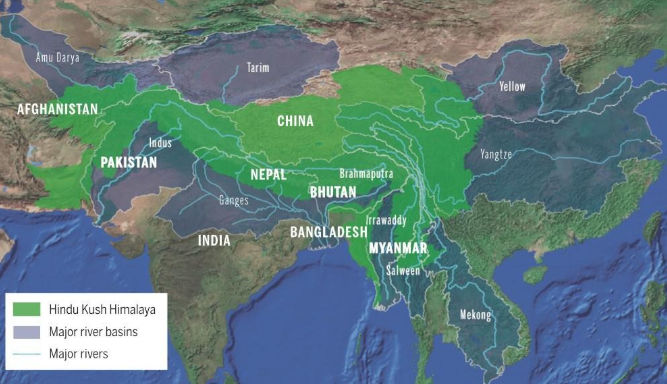
Figure 1: The Hindu Kush Himalaya region and major river basins [source: ICIMOD]
Why Nepal Matters So Much?
Nepal occupies only a small part of the HKH by area, but it plays a crucial role hydrologically. At the centre of this vast mountain-river system lies Nepal, where elevation changes rapidly, rivers gain momentum, and climate signals are amplified. Nepal sits right at the heart of this system; small on the map, but hydrologically powerful. If Asia’s water system were a circulatory network, Nepal would be one of its vital arteries. And like any artery under stress, what happens here matters far beyond our borders and neighbours. Nepal did not choose this responsibility; geography never asks for consent, but the Indian and Eurasian tectonic plates made that decision millions of years ago.
Nepal’s entire northern skyline is a continuous chain of towering peaks, including eight above 8,000 metres, along with countless other snowy sentinels. They store vast amounts of snow and ice, slowly releasing water into the rivers that tumble down steep valleys. From east to west, rivers like the Koshi, Gandaki, and Karnali carve through the country, gathering snowmelt, glacier melt, and rainfall, and carrying it onward to feed millions downstream. In a way, these mountains and rivers are like nature's own water factory, quietly operating for centuries, often unacknowledged.
Together, this system supplies water to Nepal and hundreds of millions downstream in India and Bangladesh. In other words, Nepal is not just downstream of climate impacts; it is upstream of regional water security. This creates a paradox: Nepal contributes relatively little to global greenhouse gas emissions but bears an outsized responsibility and risk regarding Asia’s water future.
How the HKH Supplies Water
Contrary to popular belief, Himalayan rivers are not fed solely by glaciers. Water in the HKH comes from three main sources: seasonal snowfall that melts, glacier ice that melts gradually, and monsoon rainfall, which dominates the annual flow. This combination explains why the idea of “glacier-fed rivers only” is misleading. Glaciers act like long-term savings accounts, releasing water slowly during dry months. Snow provides seasonal buffering, while rainfall delivers the bulk of annual discharge, often all at once, sometimes inconveniently. When these sources are in balance, they smooth out extremes, maintaining river flows even in droughts.
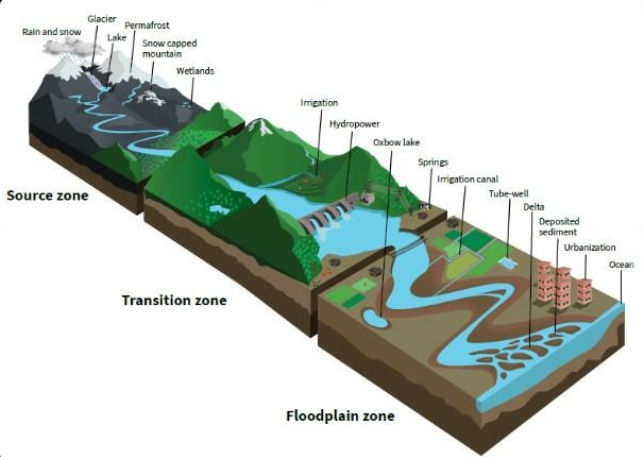
Figure 2: Schematic of mountain water flow from glaciers to plains, [source: ICIMOD]
This upstream-to-downstream pathway links the mountain climate directly to food, energy, and water security. This combination permits rivers to flow year-round, supporting irrigation, hydropower, drinking water, and ecosystems. Removing one component, glaciers, snow, or predictable rainfall, destabilise the system. The outcome is not merely a loss of water but a shift in timing, location, and pattern of water availability. Sadly, climate change does not take just one thing; it alters all three simultaneously.
Climate Change Enters the Mountains
The HKH is warming more rapidly than the global average. Even if global warming is limited to 1.5°C, the region is expected to lose at least a third of its glacier volume by 2100, with up to 80% loss under higher emissions scenarios (Wester et al., 2023; Wester et al., 2019). In mountain regions, small temperature rises can cause disproportionately large changes in snow and ice.
Glaciers are retreating. Snowlines are moving higher. Monsoon rainfall is becoming more unpredictable, with fewer rainy days but more intense downpours when it does rain (IPCC, 2021). This creates a strange and dangerous paradox: “More floods in the short term but less water in the long term.” For downstream communities, this means managing damaging floods today while facing increasing water scarcity in the future.
These changes are especially visible in high-altitude environments, where ice and water are closely linked. Glacial lakes expand as ice melts, increasing the risk of sudden outburst flood in which lakes burst through natural dams.
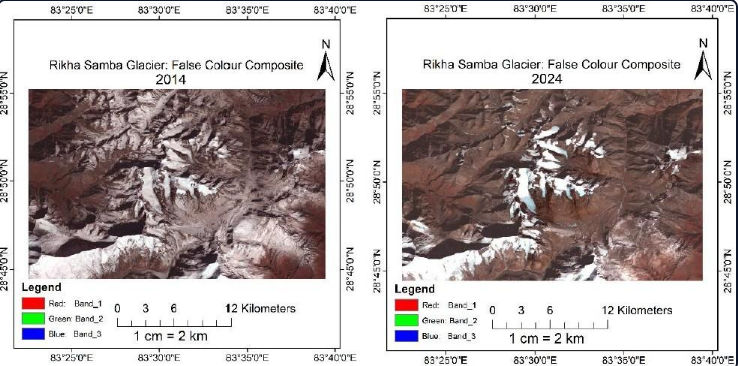
Figure 3: Rikha Samba Glacier, Nepal, 2014 vs 2024. During 10 years time, most of the snow melted early. [source: author]
A glacial lake outburst flood, or GLOF, is essentially a mountain deciding it has waited long enough. When this happens, gravity takes over, and downstream communities are given very little time to react. Meanwhile, dry-season river flows are projected to decline as glaciers lose their buffering capacity.
Nepal’s Water Security Challenges
For Nepal, climate change in the HKH translates into very real problems on the ground. Urban areas face frequent flooding, not because rainfall is unprecedented, but because drainage systems were never designed for today’s extremes. Rivers overflow, streets turn into canals, and cities repeatedly fail to anticipate these extreme events. What once counted as “extreme” rainfall is increasingly becoming the new normal.
Rural and mountain communities face the opposite problem: drying springs, declining groundwater, and increasing water-fetching distances, which particularly affect women and elderly populations. As local water sources fail, households are forced to rely on longer walks, seasonal migration, or unsafe alternatives. These contrasting experiences of too much water and too little water are happening at the same time, often within the same river basin.
These issues are interconnected. Floods, droughts, landslides, groundwater depletion, and ecosystem degradation are not separate crises; they are symptoms of a stressed mountain water system. Nepal’s vulnerability comes not from its size, but from its dependence on climate-sensitive water sources and steep terrain that amplifies extremes. Managing these challenges requires seeing water not as isolated floods or shortages, but as part of a connected mountain system.
Why This Matters Beyond Nepal?
What happens in the HKH does not stay in the HKH. Water that starts as snow, ice, or rainfall in these mountains travels thousands of kilometres before it reaches fields, cities, and power plants.
The rivers originating here support agriculture, industry, and energy production across South Asia. Changes in timing and volume of water affect food security, electricity generation, and livelihoods far downstream (Wester et al., 2019). In this sense, the HKH is not just a regional feature; it is a continental life-support system. Understanding it is not optional. It is necessary. Science has already told us what is happening. The remaining question is whether we choose to listen.
Key gaps remain:
Limited high-altitude data
Weak integration of science into planning
Low public awareness of the upstream to downstream links
This is where youth, researchers, communicators, and climate action platforms become essential. Translating science into stories, decisions, and action is no longer a side task; it is central to climate adaptation.
The mountains may be quiet, but they offer all the evidence we need. The real question is whether we are ready to understand them. The Water Tower is changing and like all infrastructure that supports billions of lives, ignoring its cracks is not a sensible choice. Listening, learning, and acting now will determine whether Asia’s Water Tower continues to sustain life or starts sending SOS signals we can no longer ignore.
References
Bolch, T., Shea, J. M., Liu, S., Azam, F. M., Gao, Y., Gruber, S., Immerzeel, W. W., Kulkarni, A., Li, H., Tahir, A. A., Zhang, G., & Zhang, Y. (2019). Status and change of the cryosphere in the extended hindu kush himalaya region. In P. Wester,
A. Mishra, A. Mukherji, & A. B. Shrestha (Eds.), The hindu kush himalaya assessment: Mountains, climate change, sustainability and people (pp. 209–255). Springer International Publishing. https://doi.org/10.1007/978-3-319-92288-1 7
ICIMOD. (2019). Major river basins in the hindu kush himalaya [Available at ICIMOD Regional Database System].
IPCC. (2021). Climate change 2021: The physical science basis. contribution of working group i to the sixth assessment report of the intergovernmental panel on climate change (V. Masson-Delmotte, P. Zhai, A. Pirani, S. L. Connors, C. P´ean, S. Berger,
N. Caud, Y. Chen, L. Goldfarb, M. I. Gomis, M. Huang, K. Leitzell, E. Lonnoy,
J. B. R. Matthews, T. K. Maycock, T. Waterfield, O. Yelek¸ci, R. Yu, & B. Zhou, Eds.). Cambridge University Press. https://doi.org/10.1017/9781009157896
Wester, P., Chaudhary, S., Chettri, N., Jackson, M., Maharjan, A., Nepal, S., & Steiner,
J. F. (Eds.). (2023). Water, ice, society, and ecosystems in the hindu kush himalaya: An outlook. International Centre for Integrated Mountain Development (ICIMOD). https://doi.org/10.53055/ICIMOD.1028
Wester, P., Mishra, A., Mukherji, A., & Shrestha, A. B. (Eds.). (2019). The hindu kush himalaya assessment: Mountains, climate change, sustainability and people. Springer International Publishing. https://doi.org/10.1007/978-3-319-92288-1