


Climate Change, the New Author of Mountain Hydrology
Climate change is often framed as an external stress applied to otherwise stable hydrological systems. In mountain regions, this framing fails. Warming does not merely intensify existing variability; it alters the internal logic by which mountain water systems function. Processes that once buffered climate variability, delayed melt, phased release, and seasonal predictability are being reorganized.
Historically, the hydrology of the Hindu Kush Himalaya (HKH) was governed by timing offsets. Snow accumulated during cold months, glaciers integrated multi-year climate signals, and meltwater arrived downstream well after precipitation events occurred. This temporal separation between input and output created stability. Climate change is collapsing these separations.
Rising temperatures compress hydrological processes into shorter windows. Melt begins earlier, precipitation phases shift, and rainfall increasingly dominates runoff generation. As a result, water arrives faster, less predictably, and more synchronously with hazards. The system no longer moderates variability; it increasingly mirrors it. This shift marks a fundamental change in system behavior. Mountains are transitioning from delayed-response systems to near-real-time responders to atmospheric forcing (Wester et al., 2019). Understanding this transition is essential before examining individual components such as glaciers or snowpacks in isolation.
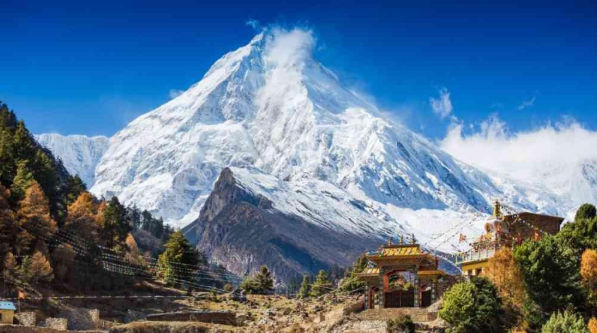
Figure 1: A representative peak in HKH.
Source: https://www.preventionweb.net/news/water-ice-society-ecosystems-hindu-kush-himalaya
Why Warming Hits Mountains First
Mountain regions respond to climate change earlier and more strongly than lowlands due to a combination of atmospheric and surface processes known as elevation-dependent warming (EDW). Observations across the HKH show warming rates exceeding global averages, particularly at higher elevations (Pepin et al., 2015; Rangwala et al., 2023).
Several mechanisms drive this amplification. Reduced snow cover lowers surface albedo, increasing solar absorption. Thinner atmosphere enhances radiative forcing. Changes in cloud dynamics and water vapor feedbacks further amplify warming at altitude. These processes collectively mean that a global temperature increase of 1.5 °C does not translate uniformly; in high mountain zones, effective warming can be substantially higher. One of the most consequential outcomes of this warming is phase change. Precipitation that historically fell as snow increasingly falls as rain, even at elevations previously considered reliably cold. This transition does not require large temperature increases; it hinges on crossing narrow thermal thresholds around freezing.
In the HKH, observed snowline elevations have risen, and the proportion of winter precipitation falling as rain has increased in many basins (Bolch et al., 2019; Wester et al., 2023). This change alters runoff generation pathways without yet invoking long-term storage loss. Rain generates immediate runoff; snow delays it. The balance between the two determines system responsiveness. Mountains therefore act as early responders to climate forcing. They register changes not because they are fragile, but because their hydrology is tightly coupled to temperature thresholds.
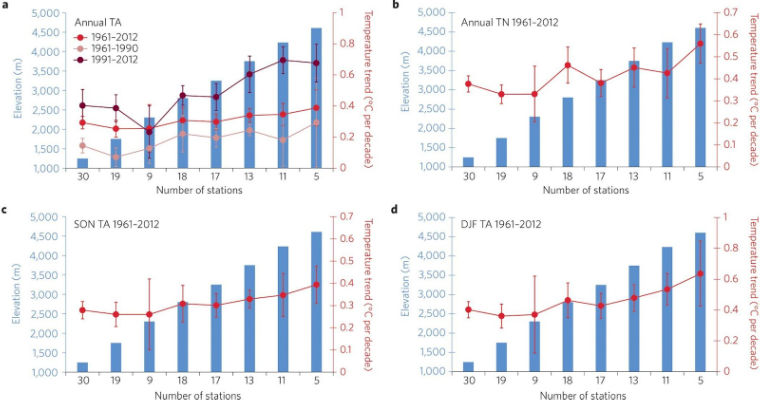
Figure 2: Elevation-dependent warming trends in mountain regions. Source: https://www.nature.com/articles/nclimate2563
The Collapse of Predictable Timing
Perhaps the most consequential hydrological change underway in the HKH is not a reduction in total water volume, but the loss of reliable timing. Mountain water systems have long been valued for delivering water when downstream demand peaks particularly during dry seasons.
Warming disrupts this alignment. Earlier onset of melt advances spring and early-summer flows, while late-season contributions decline (Immerzeel et al., 2020). Rivers peak sooner, often before agricultural and energy demand reaches its maximum. This shift creates a mismatch between availability and need. At the basin scale, observations from the Koshi, Gandaki, and Indus headwaters indicate advancing hydrograph peaks and reduced flow persistence into late summer and autumn (Lutz et al., 2014). While monsoon rainfall can compensate for volume, it cannot replace temporal reliability.
Increasing dependence on monsoon rainfall introduces new vulnerabilities. Monsoon precipitation is episodic, spatially heterogeneous, and increasingly variable. When river systems rely more heavily on rainfall timing, hydrology becomes more sensitive to short-term atmospheric fluctuations rather than integrated seasonal signals.
The system problem, therefore, is not simply water scarcity. It is temporal disorganization. Water arrives earlier, faster, and in bursts, eroding the functional predictability upon which downstream systems were built.
From Rare Events to System Behavior
Extreme hydrological events in mountain regions were once considered anomalies, outliers driven by unusual meteorological conditions. Climate change is altering this framing. Extremes are increasingly becoming emergent properties of the system. Across the HKH, total annual precipitation has not increased uniformly. Instead, rainfall is being redistributed into fewer but more intense events. This intensification increases runoff efficiency, overwhelms infiltration capacity, and elevates flood risk even when seasonal totals remain unchanged.
One particularly disruptive process is rain-on-snow. When warm rainfall falls on existing snowpacks, it rapidly mobilizes stored water, generating runoff volumes far exceeding rainfall alone. These events act as hydrological triggers, synchronizing melt and precipitation into single destructive pulses (Cohen et al., 2015).
Compound events are also becoming more common. Heatwaves accelerate melt; intense rainfall follows; unstable slopes fail. These cascading sequences introduce strong nonlinearity small atmospheric perturbations produce disproportionate hydrological responses.
In the HKH, recent flood disasters have increasingly exhibited such compound characteristics, challenging traditional hazard classification frameworks (Wester et al., 2019). The system no longer responds proportionally to forcing; it reacts abruptly once thresholds are crossed.
When Rivers Carry More Than Water
Hydrological change does not remain confined to discharge metrics. Altered flow regimes mobilize landscapes, turning rivers into conveyors of sediment, debris, and geomorphic change. Increased rainfall intensity and slope instability enhance landslide frequency across the HKH. These landslides inject large sediment volumes into river networks, often in pulses that propagate far downstream. Once entrained, sediment alters channel geometry, reduces conveyance capacity, and raises flood levels for a given discharge. Aggradation in riverbeds increases flood risk even without changes in flow magnitude. Reservoirs and hydropower infrastructure are particularly vulnerable, as elevated sediment loads reduce storage capacity and operational efficiency (Schleiss et al., 2016).
Importantly, sediment acts as a feedback mechanism. Altered hydrology mobilizes sediment; sediment reshapes channels; reshaped channels modify flow behavior. Rivers become dynamically unstable systems rather than predictable conduits. In Nepal’s major river systems, this instability has already manifested as shifting channels, unexpected inundation zones, and infrastructure damage disconnected from traditional flood recurrence assumptions.
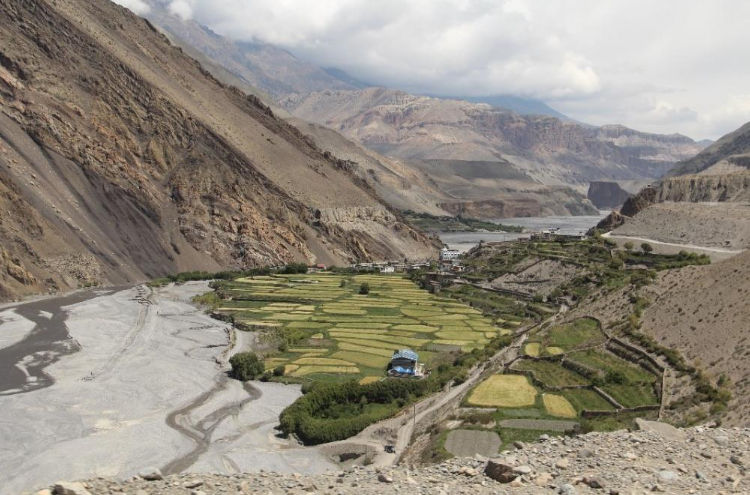
Figure 3: Kaligandaki, a major river in Nepal with one of the highest sediment concentrations.
Source: https://www.ntnu.edu/hydrocen/fransed-in-the-himalayas
Mountains as Amplifiers, Not Buffers
For centuries, mountain water systems buffered climate variability. Snowpacks and ice delayed release, terrain moderated flows, and rivers delivered water with remarkable consistency relative to precipitation variability. Climate change is reversing this role. Mountains are increasingly acting as amplifiers transmitting atmospheric variability downstream with reduced attenuation.
This transition is not linear. It involves thresholds beyond which buffering capacity collapses rapidly. Once timing offsets shrink sufficiently, systems flip behaviorally: floods intensify, droughts deepen, and variability increases even if mean conditions change modestly.
Crucially, this shift introduces irreversibility on human timescales. Even if temperatures stabilize, reorganized hydrological pathways may not return to prior states due to landscape change, sediment redistribution, and infrastructure adaptation locked to new regimes. In the HKH, evidence suggests that several basins are approaching or have crossed such functional thresholds (Immerzeel et al., 2020; Wester et al., 2019). The mountains are no longer smoothing climate signals; they are sharpening them.
Early Warnings Written in High Elevation
Mountain regions respond first to climate change, not because they are uniquely vulnerable, but because their hydrology is tightly coupled to temperature, phase, and timing thresholds. This makes them sentinels of future hydrological change. What unfolds today in the HKH foreshadows what downstream and lowland systems will inherit later: compressed seasonality, intensified extremes, sediment-laden floods, and reduced predictability. The signals exported by mountain rivers are not diluted with distance; they are integrated into larger systems. This sentinel role carries an important implication.
Understanding mountain hydrology under climate change is not a regional concern; it is a preview of systemic transformation. To understand what is being lost, and what may still be preserved, the next step is to examine how water has historically been stored, delayed, and released in high mountain systems and how those mechanisms are now being destabilized.
References
Bolch, T., Shea, J. M., Liu, S., Azam, F. M., Gao, Y., Gruber, S., Immerzeel, W. W., Kulkarni, A., Li, H., Tahir, A. A., Zhang, G., & Zhang, Y. (2019). Status and change of the cryosphere in the extended hindu kush himalaya region. In P. Wester,
A. Mishra, A. Mukherji, & A. B. Shrestha (Eds.), The hindu kush himalaya assessment: Mountains, climate change, sustainability and people (pp. 209–255). Springer International Publishing. https://doi.org/10.1007/978-3-319-92288-1 7
Cohen, J., Screen, J. A., Furtado, J. C., Barlow, M., Whittleston, D., Coumou, D., Francis, J., Dethloff, K., Entekhabi, D., & Overland, J. (2015). Recent arctic amplification and extreme mid-latitude weather. Nature Geoscience, 7 (9), 627–637. https://doi. org/10.1038/ngeo2234
Immerzeel, W. W., Lutz, A. F., Andrade, M., et al. (2020). Importance and vulnerability of the world’s water towers. Nature, 577, 364–369. https://doi.org/10.1038/s41586- 019-1822-y
Lutz, A. F., Immerzeel, W. W., Shrestha, A. B., & Bierkens, M. F. P. (2014). Consistent increase in high asia’s runoff due to increasing glacier melt and precipitation. Nature Climate Change, 4, 587–592. https://doi.org/10.1038/nclimate2237
Pepin, N., Bradley, R. S., Diaz, H. F., Baraer, M., Caceres, E. B., Forsythe, N., Fowler, H., Greenwood, G., Hashmi, M. Z., & Liu, X. (2015). Elevation-dependent warming in mountain regions of the world. Nature Climate Change, 5, 424–430. https :
//doi.org/10.1038/nclimate2563
Rangwala, I., Pepin, N., Vuille, M., & Miller, J. (2023). Elevation-dependent warming in mountains: Mechanisms and consequences. Earth-Science Reviews, 235, 104234. https://doi.org/10.1016/j.earscirev.2022.104234
Schleiss, A. J., De Cesare, G., Oehy, C., & Mu¨ller, M. (2016). Reservoir sedimentation. Journal of Hydraulic Research, 54 (6), 595–614. https://doi.org/10.1080/00221686. 2016.1225320
Wester, P., Chaudhary, S., Chettri, N., Jackson, M., Maharjan, A., Nepal, S., & Steiner,
J. F. (Eds.). (2023). Water, ice, society, and ecosystems in the hindu kush himalaya: An outlook. International Centre for Integrated Mountain Development (ICIMOD). https://doi.org/10.53055/ICIMOD.1028
Wester, P., Mishra, A., Mukherji, A., & Shrestha, A. B. (Eds.). (2019). The hindu kush himalaya assessment: Mountains, climate change, sustainability and people. Springer International Publishing. https://doi.org/10.1007/978-3-319-92288-1