


The Hindu Kush Himalaya as a Multilayered Water Reservoir
The Hindu Kush Himalaya (HKH) functions not as a single water source but as a vertically stacked reservoir system. Water enters this system primarily as precipitation, but it is stored, delayed, and released through a hierarchy of physical compartments operating on different timescales. Snowpacks, firn layers, glacier ice, debris-covered ice bodies, permafrost, groundwater, and river channels each play distinct roles in regulating how and when water moves downstream (Immerzeel et al., 2020; Wester et al., 2019).
Unlike lowland basins, where storage is dominated by soils and aquifers, mountain hydrology relies heavily on cryospheric storage. Elevation creates thermal gradients that allow water to be held in frozen form for months to centuries. This vertical stratification gives the HKH its historical capacity to buffer seasonal and interannual variability, smoothing river flows long after precipitation events have ended (IPCC, 2021).
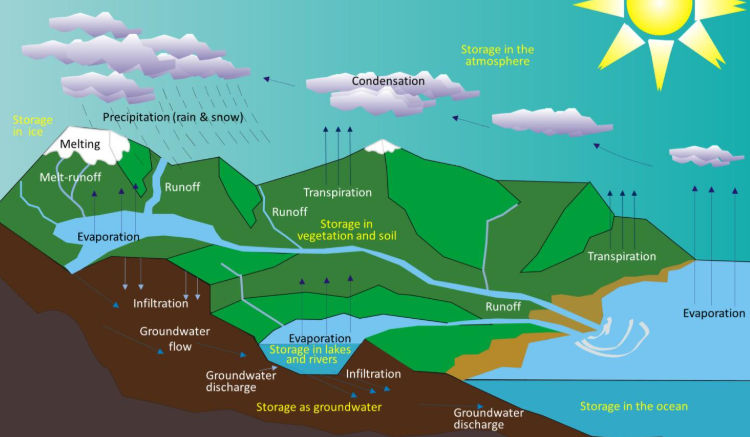
Figure 1: A basic representation of water cycle diagram.
Source: https://opentextbc.ca/physicalgeology2ed/chapter/13-1-the-hydrological-cycle/
Understanding HKH hydrology, therefore, requires moving beyond rivers as conduits and toward storage as architecture. Rivers integrate what mountains release, but do not determine the timing of that release. That control lies upstream, embedded in snow, ice, and subsurface systems.
Seasonal Snowpacks: Short-Term Storage with Outsized Influence
Seasonal snowpack represents the most dynamic and spatially extensive form of water storage in the HKH. Snow accumulates during winter and early spring, particularly in the western and central HKH, where westerly disturbances dominate precipitation regimes (Lutz et al., 2014). This snow does not immediately contribute to runoff. Instead, it acts as a delayed reservoir, releasing water gradually during melt periods.
The hydrological importance of snowpack lies less in total volume than in timing. Snowmelt typically sustains spring and early summer flows, bridging the gap between dry winters and monsoon onset. In snow-dominated catchments, melt timing exerts first-order control on river hydrographs, influencing irrigation schedules, ecological processes, and reservoir inflows downstream.
Elevation plays a decisive role. Snow persistence increases sharply above critical hypsometric thresholds, meaning that relatively small elevation bands can disproportionately regulate basin-scale runoff. This sensitivity explains why snow-dominated basins often exhibit strong year-to-year variability even when annual precipitation remains stable.
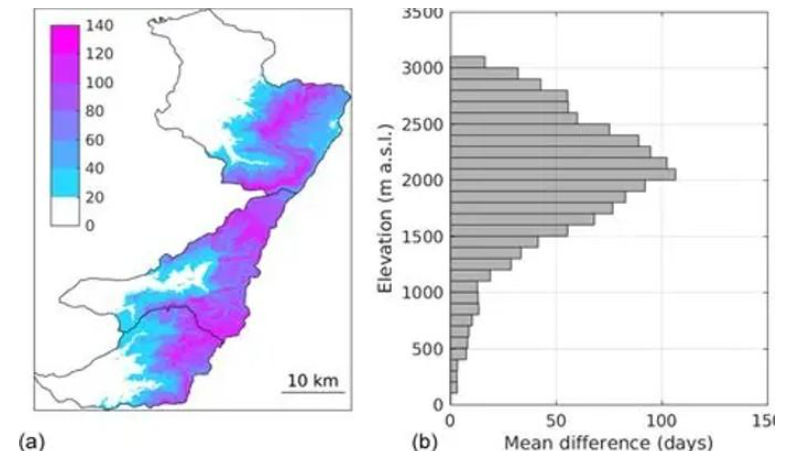
Figure 2: (a) Map of the difference in days between the snow cover duration. (b) Mean difference by elevation band,
Source : https://hess.copernicus.org/articles/24/1527/2020/
Snowpack storage is therefore best understood as a short-term but high-leverage component of the HKH water system, one that governs seasonal reliability rather than long-term supply.
Glacier Ice and Firn: The Long Memory of HKH Rivers
Glacier ice represents the longest-term water storage in the HKH, with residence times spanning decades to centuries. Unlike seasonal snow, glacier ice accumulates slowly through compaction and refreezing processes within the firn layer, where meltwater percolates and is retained before becoming part of the glacier body (Bolch et al., 2019).
This slow turnover gives glaciers their buffering capacity. During dry years or delayed monsoons, glacier melt can sustain baseflows when other sources diminish. This effect is particularly pronounced in the Indus basin, where glacier contributions dominate summer runoff, in contrast to the Ganges and Brahmaputra, where monsoon rainfall plays a larger role.
Firn layers are critical intermediaries. By temporarily storing meltwater and releasing it gradually, firn smooths short-term fluctuations in melt rates. This internal regulation is often invisible in river discharge records but is fundamental to the long-term stability of glacier-fed systems.
Glaciers thus act as hydrological memory, retaining signals of past climate and releasing them slowly into present-day rivers.
Debris-Covered Glaciers and Hidden Ice Reservoirs
A defining characteristic of the HKH is the prevalence of debris-covered glaciers. Thick mantles of rock and sediment insulate underlying ice, reducing melt rates in some areas while simultaneously creating localized melt hotspots where debris cover is thin or absent.
These heterogeneous surfaces give rise to ice cliffs, supraglacial ponds, and englacial conduits that bypass traditional melt pathways. Water released through these features often enters streams rapidly, shortening lag times between melt and runoff. In this way, debris-covered glaciers function as complex mosaics of insulation and acceleration rather than uniform reservoirs.
Beyond visible glaciers, the HKH contains extensive hidden ice stores, including buried glacier remnants and rock glaciers. These features store water in frozen form beneath debris layers and contribute meltwater slowly, often sustaining springs and headwater streams during dry periods (Wester et al., 2019). These hidden reservoirs complicate traditional assessments of glacier storage, reinforcing the need for region-specific hydrological understanding.
Permafrost and Mountain Groundwater: Invisible but Persistent Stores
Permafrost underlies large portions of the high HKH, particularly above 4,500–5,000 meters. While often discussed in polar contexts, mountain permafrost plays a distinct hydrological role by acting simultaneously as a storage medium and a hydraulic barrier (IPCC, 2021).
Frozen ground limits deep infiltration, forcing meltwater and rainfall to move laterally through shallow subsurface layers. During the seasonal thaw, the active layer temporarily stores water, releasing it gradually to springs and streams. This process sustains baseflows long after surface snow has melted.
Mountain groundwater systems further extend storage timescales. Recharge from snow and glacier melt feeds fractured bedrock aquifers, which release water slowly and predictably. These systems are critical for maintaining perennial flows in mid-elevation catchments, yet they remain among the least quantified components of HKH hydrology.
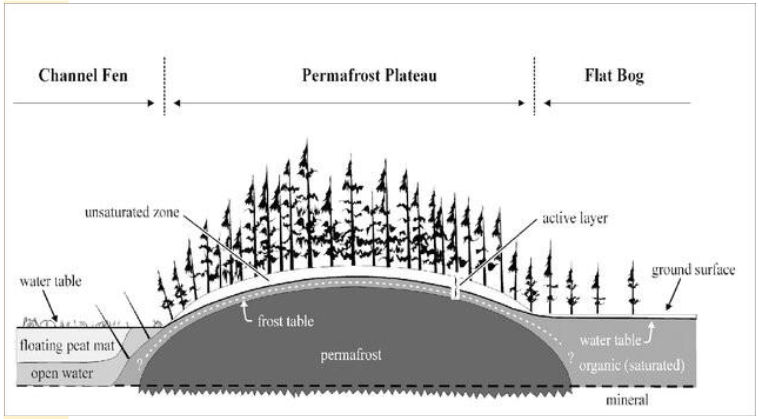
Figure 3: Schematic cross-section of a permafrost plateau flanked by a channel fen on one side, and a flat bog on the other.
Source: https://www.scottycreek.com/media/documents/publications/39_Quinton%20et%20al.%2C%202009b.pdf
Though invisible, subsurface storage provides continuity in an otherwise episodic hydrological environment.
Rivers as Integrators of Mountain Storage and Release
Rivers in the HKH do not generate water; they integrate the release of upstream storage. Discharge at any point reflects the cumulative contributions of snowmelt, glacier melt, groundwater, and rainfall, each arriving with distinct lags and attenuations. This integration produces characteristic river regimes. The Indus exhibits strong summer peaks driven by glacier and snowmelt, while the Ganges and Brahmaputra display monsoon-dominated hydrographs with secondary cryospheric contribution.
Lag times matter. Meltwater released at high elevations may take days to weeks to propagate downstream, during which it is modulated by channel storage, floodplains, and human infrastructure. As a result, downstream hydrographs encode information about upstream storage health rather than immediate precipitation alone. Rivers thus function as diagnostic tools, revealing the state of mountain storage systems through their flow patterns.
Storage Timescales, Hydrological Memory, and System Stability
The defining feature of HKH hydrology is its hierarchy of storage timescales. Snow operates on monthly scales, groundwater on seasonal to annual scales, and glacier ice on decadal scales. Together, these compartments create hydrological memory, the ability of the system to moderate variability over time.
Historically, this memory allowed mountain systems to absorb shocks and release water gradually, ensuring downstream reliability even under variable climatic conditions. Timing, more than volume, governed system stability.
Understanding this architecture is essential because it clarifies what mountain water systems do before considering how they change. To grasp what is at risk under warming, one must first understand how storage once functioned.
References
Bolch, T., Shea, J. M., Liu, S., Azam, F. M., Gao, Y., Gruber, S., Immerzeel, W. W., Kulkarni, A., Li, H., Tahir, A. A., Zhang, G., & Zhang, Y. (2019). Status and change of the cryosphere in the extended hindu kush himalaya region. In P. Wester,
A. Mishra, A. Mukherji, & A. B. Shrestha (Eds.), The hindu kush himalaya assessment: Mountains, climate change, sustainability and people (pp. 209–255). Springer International Publishing. https://doi.org/10.1007/978-3-319-92288-1 7
Immerzeel, W. W., Lutz, A. F., Andrade, M., et al. (2020). Importance and vulnerability of the world’s water towers. Nature, 577, 364–369. https://doi.org/10.1038/s41586- 019-1822-y
IPCC. (2021). Climate change 2021: The physical science basis. contribution of working group i to the sixth assessment report of the intergovernmental panel on climate change (V. Masson-Delmotte, P. Zhai, A. Pirani, S. L. Connors, C. P´ean, S. Berger,
N. Caud, Y. Chen, L. Goldfarb, M. I. Gomis, M. Huang, K. Leitzell, E. Lonnoy,
J. B. R. Matthews, T. K. Maycock, T. Waterfield, O. Yelek¸ci, R. Yu, & B. Zhou, Eds.). Cambridge University Press. https://doi.org/10.1017/9781009157896
Lutz, A. F., Immerzeel, W. W., Shrestha, A. B., & Bierkens, M. F. P. (2014). Consistent increase in high asia’s runoff due to increasing glacier melt and precipitation. Nature Climate Change, 4, 587–592. https://doi.org/10.1038/nclimate2237
Wester, P., Mishra, A., Mukherji, A., & Shrestha, A. B. (Eds.). (2019). The hindu kush himalaya assessment: Mountains, climate change, sustainability and people. Springer International Publishing. https://doi.org/10.1007/978-3-319-92288-1